Showing posts with label sp futures. Show all posts
Showing posts with label sp futures. Show all posts
Friday, March 25, 2011
Climbing the Wall of Worry
There is the saying that strong markets climb the “wall of worry.” It sure feels like that nowadays. Tunisia, Egypt, Bahrain, Yemen, Syria, and Libya are rumbling to various degrees. The US has just entered into yet another war in the Middle East. Japan is glowing and no one seems to give a damn. Oil is over a $100 bucks a barrel. The US Government is negotiating to stay open for business a little bit longer. States are finding that they are facing critical shortages of something really important--money! Workers cannot find jobs. Greece, Ireland, and Portugal are desperate. The list seems to go on and on, yet the market seems to be acting pretty well…hmmmm…

Thursday, March 10, 2011
OILY PIGS
If oil prices stay high for a prolonged period of time it will be put incredible pressure on the Greek, Irish, and Portuguese economies. The risk of default increases as the price of oil rises. European leaders will need to be more proactive. Mr. Trichet is talking about raising interest rates, while here in the United States, Mr. Bernanke is giving indications that rates will not be raised. Why is Europe jumping so quickly to raise interest rates? Yes, I know the inflation fear is present, but default fears need to be addressed. I believe the US stock market is starting to smell it.
Wednesday, March 2, 2011
TRADING CDS AIR
The Wall Street Journal recently reported that banks and hedge funds are trading credit default swaps on General Motors bonds that do not exist. All I can say is here we go again. How can these kinds of things go on? I am all for free market capitalism, but when my money and yours is being used to keep these guys operating when they F*up, then something has to give. The value of derivatives is linked to some sort of “underlying” asset. It now seems that the underlying security can be a concept and an idea. Wow, got to give credit to the genius that brought this about….
Monday, February 28, 2011
IMMANUEL KANT AND MARKET VALUE
I was recently at my local library’s book sale and came across a set of Harvard Classics that I could not pass up. I bought them and began to read Immanuel Kant’s, Fundamental Principles of the Metaphysic of Morals. Mr. Kant can be pretty dense and obscure. Reading his writings reminds me of a line by the comic, Steve Martin, who believed he had taken just enough philosophy to screw him up for the rest of his life. Reading Mr. Kant can have a similar effect.
Nonetheless, Immanuel Kant can be pretty easy to understand (sometimes) and there were a few brief moments of pure, lucid thought that I could follow. I found the following interesting…
“In the kingdom of ends everything has either Value or Dignity. Whatever has a value can be replaced by something else which is equivalent; whatever, on the other hand, is above all value, and therefore admits of no equivalent, has a dignity.
Whatever has reference to the general inclinations and wants of mankind has a market value; whatever, without presupposing a want, corresponds to a certain taste, that is to a satisfaction in the mere purposeless play of our faculties, has a fancy value; but that which constitutes the condition under which alone anything can be an end in itself, this has not merely a relative worth, i.e., value, but an intrinsic worth, that is dignity.”
As traders we always deal with the concept of value and price. Stocks can have market value and fancy value. I find it interesting that the word and concept Mr. Kant uses is “dignity” for something which is beyond value. As a trader this tells me to short fancy value and go long dignity.
Wednesday, January 26, 2011
How to Get Investment Ideas from the Pros
Here is a good way to get an idea of what the well-known investors are holding in their portfolios and funds. By searching 13F filings on this site, one can get some insights into industries and companies that investors like Mr. Paulson, Mr. Klarman, or Mr. Soros are holding. Periodic searches also allow one to see where they are reducing their positions. Hope this is helpful.
Monday, January 24, 2011
The Seven Habits of Highly Effective People
Stephen R. Covey, the author of The Seven Habits of Highly Effective People, first published this bestseller in 1990. Here is a nice summary of the ideas in this book. The seven habits concern personal change and how one can become more effective. One of the parts I find interesting is the “win/win” situation. One should seek agreements, situations, and relationships where there is win/win. This is what we are creating at TradingXYZ. The second is that we see things not as they are, but as we are conditioned to seeing them. This principle is helpful to remember when we look at the market and try to make sense of it. Viktor Frankl’s attitude towards a horrific situation is a great lesson for all people. Humans have the freedom to choose. Frankl’s book, Man’s Search for Meaning, is another that I have on my list of things to read in the near future.
Tuesday, January 11, 2011
Correlations and Comparative Statistics - Stocks
There are many stock screening websites that may be useful, for example MSN Money and Google Finance, but I also like these two. The first is Wolfram, which allows the user to input a variety of stocks and make comparisons in different ways. The second is the Select SPDR site which calculates correlations. Although these things can be done in Excel, sometimes it is helpful to get quick information. I hope you find them useful.
Wednesday, December 22, 2010
Mr. Stephen Schwarzman’s lecture at Yale
I really enjoyed listening and watching Mr. Stephen Schwarzman’s lecture at Yale. Mr.Schwarzman discussed many topics such as the nature of private equity, real estate, successful and failed deals, and how the financial crisis occurred and evolved. I have read and heard so much of the financial crises by now, that I thought there was nothing new that I could learn. I was wrong.
I learned from Mr. Schwarzman’s lecture that government policies and laws can lead to unintended negative consequences in our society. Although this was not the main point of his discussion, he did refer to a few government actions that had clear and unintended negative consequences for our society.
The first was the start of the real estate bubble, which began with the US government’s policy to get more people into homes. Although this was a good policy, it wound up turning into a fiasco, with all the unintended consequences to come later. For example, Mr. Schwarzman stated that subprime mortgages at one point were 2-3% of all mortgages; and by the end they had become more than 30%. He also described how 87% of pooled mortgages which were securitized were given AAA ratings. This misled investors into thinking that these securities were safe and could not default. Mr. Schwarzman believes historians will look back at this time and wonder how AAA ratings were given to these securities in the first place. In addition, he wonders how so many investors believed in these ratings and were fooled by them. In my opinion it’s pretty simple; just like there is a fog of war and a fog of panic, there is also the fog of greed.
The second unintended negative consequence came from the passage of the Sarbanes-Oxley law. This law was passed after the Enron scandal and created fair value accounting, also known as FAS 157. Mr. Schwarzman described how FAS 157 forced financial institutions to take losses before defaults actually occurred. These losses, in turn, created a crisis of confidence in financial institutions which eventually morphed into the much bigger financial crisis.
His stories of successful deals, US Steel and Celanese, and unsuccessful ones, an Argentinian cell phone company, were also interesting. One point he stressed was that capital always comes back. Even though there is a credit crunch occurring, he is optimistic that credit and capital will come back. He mentioned the past credit crunches of 1975, 1982, 1987, and 1990-1991.
I also liked his discussion about failure. He stated how he hates failure and when it does occur that he tries to learn from it. Failure can be a blessing in disguise. Mr. Schwarzman is a winner because he does not like to fail. This was worth watching.
Tuesday, December 21, 2010
60 Minutes and The Day of Reckoning
This past Sunday night, “60 Minutes,” the television show, had a segment on the looming financial crisis of local, municipal, and state governments. The analyst who was interviewed, along with Governor Chris Christie of New Jersey, basically said the same thing. The Day of Reckoning is here and will need to be addressed. What does this mean? It means more catastrophic losses and bailouts by the US taxpayer.
According to the analyst, this will begin to occur within the next 12 months. Mr. Christie says that it is already here. This is serious and no one seems to care. For years I have been hearing of unfunded pension liabilities, creative accounting, and budget deficits-yet no one has done anything about it.
The show also stated how Illinois is effectively bankrupt and a deadbeat. Why have we not heard more about these issues? Are we ostriches with our heads in the sand ? Is our government unwilling to talk about this future crisis? I commend “60 Minutes” for this segment, but it makes me nervous. Just like everything else that is happening…
Thursday, December 16, 2010
MBA and the Top Business Schools
Here’s a pretty good site that summarizes a typical MBA program. Also, Bloomberg Businessweek has released what it considers the best business schools in the country.
Thursday, December 9, 2010
Mr. Taleb and Mr. Mandelbrot
Here is a gentleman that is fighting ingrained thoughts, the status quo, and money interests. Mr. Taleb is challenging fundamental concepts that are being used by bankers and financiers. There really is no credible theory to replace what has been used and established on Wall Street over many years. He does mention in this video that VAR (Value at Risk) analysis should be immediately discarded. The question I have is what replaces it? No bank or risk manager can go out there today and justify what they are doing, because there is no “standard model” that they can stand on.
I agree with Mr. Taleb’s views, but throwing out old theories and replacing them with theories that use power laws, etc. is what Mr. Taleb argues for in his books. It’s going to take a long time to change the way things are done. In fact, what is upsetting is that it seems to me that the bankers and financiers have “won.” Nothing has changed and the system is more fragile than ever. Maybe the whole thing just has to implode before things change. I hope not, but it sure feels like that is the way things are moving.
What can we say about Benoit Mandelbrot? He is a visionary. His insights have been brushed aside by the establishment, but someday, if not already, he will eventually be proven right.
Wednesday, December 8, 2010
Mr. Warren Buffett’s two rules for making money
Mr. Warren Buffett has been quoted as saying the first rule of making money is not to lose money. The second rule is to remember the first rule.
This is a simple philosophy that is difficult to do. The point is that an investor cannot dig a hole in their capital. Preserving capital, limiting loss, and having a disciplined money management approach are some of the keys to successful investing and trading.
This is a simple philosophy that is difficult to do. The point is that an investor cannot dig a hole in their capital. Preserving capital, limiting loss, and having a disciplined money management approach are some of the keys to successful investing and trading.
Thursday, December 2, 2010
Winston Churchill's Big Black Dog - Biggs - Trading
In Mr. Biggs book, Hedgehogging, he discusses the periodic bouts of depression that Winston Churchill would have.
“Winston Churchill, whose career had its ups and downs and also was plagued with bouts of depression, spoke of the huge, foul-smelling black dog with breath like the sewer, which appeared uninvited and sat heavily on his chest, pinning him down.”
Well, in all my years of trading, I can empathize with Mr. Churchill. That big, black dog is now visiting me and sitting on my chest.
All professional money managers and traders understand that there will be times when they underperform. Mr. Buffett, I believe, said that it can be up to 30% of the time that managers underperform. Mr. Biggs discusses the frustration money managers have with their investors when they do not perform well. As soon as a fund does not perform well, investors usually take the money and run, instead of waiting and being patient. Investors immediately begin to search for someone else who can make them money.
Generally, the good money manager is one who performs well, on average, over a long time frame. Mr. Biggs argues that investors would probably be better off staying with a manager with a proven long term record, rather than going out and searching for superstars and returns, just because of a bad year.
Just some food for thought…
Wednesday, December 1, 2010
Emini Trading Performance for 2010
Our trading for 2010 is now completed (we do not trade in December). Our performance for 2010 was disappointing and frustrating. Tradingxyz’s point losses for 2010 were 2.50 points. Depending on the risk level chosen, this would have been:
1% risk = -.5%
2% risk = -1.1%
3.5% risk = -2.5%
This was our first losing year relative to our historical performance. Although the losses were relatively small, they were painful. It is always painful to lose money. In trading it is well known that losses are much more painful and memorable than gains. It is even more painful to underperform, but we will withhold judgement on this until the end of the year, when our performance benchmarks will be computed.
Nonetheless, one of the main aspects of money management and risk control is to not get blown out of the water. Good trading is about preserving capital and having it available in order to capture future opportunities. Our historical performance has been excellent and will return. The loss for 2010 was small, and generally insignificant, when one has a longer term perspective. Our capital has been preserved and we look forward to a much better year of trading in 2011.
Tuesday, November 30, 2010
Is QE2 Failing?
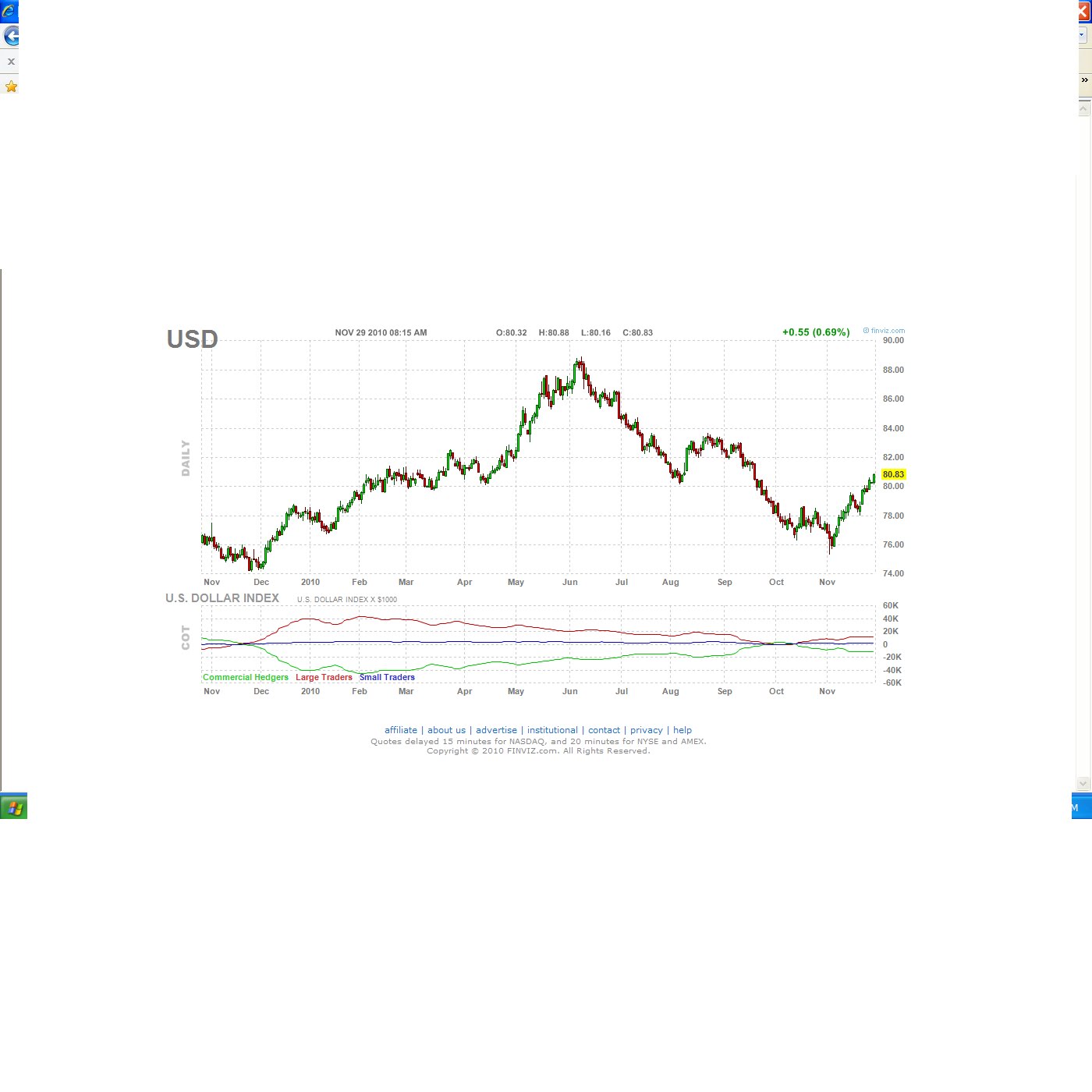
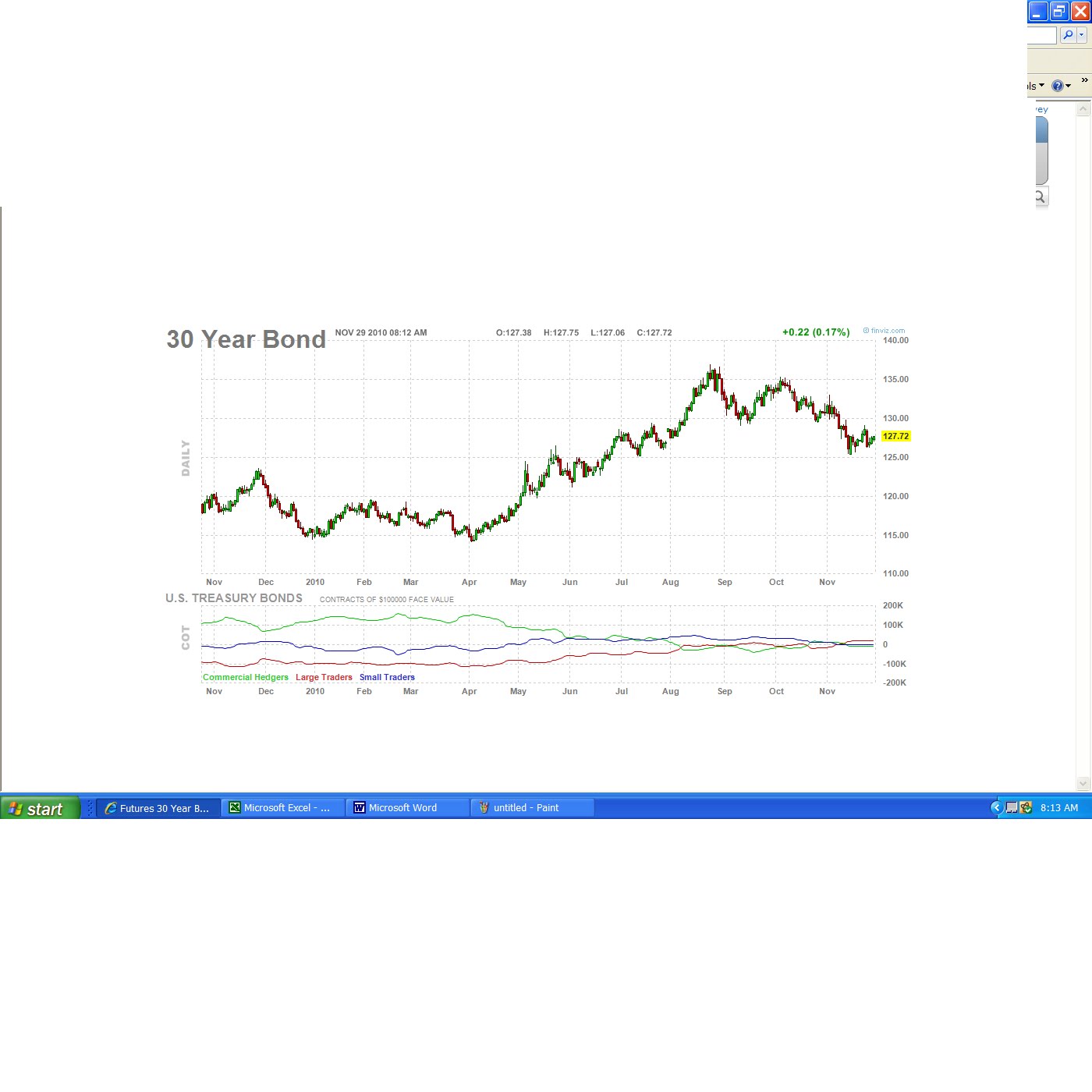
All the reasons for the Fed’s QE2 program have now been explained; they are trying to lower the value of the US dollar, lower long term interest rates, and that they are trying to avoid deflation. A quick look at the US dollar and 30 year bond charts, since early November, show that exactly the opposite is happening.
The US dollar has appreciated and bond prices have gone down; yields have gone up. Does this mean that the program is not having its intended effects? Or does it mean that the markets already anticipated the Fed’s move and moved before the Fed announcement? I know it may be early, but so far, so bad.
I also would not rule out that other countries, particularly China, may be behind this. China has been vocal and has stated that they are not happy with the Fed’s program. Maybe China is dumping some of its bond holdings and buying dollars? Who knows? …but I would not rule this out as a possibility. China has been recently flexing its economic muscle and they have even downgraded US bond credit ratings, so it’s not impossible that they are moving to counter the Fed’s actions.
Tuesday, November 23, 2010
Mr. Andrew Redleaf Lecture
Recently I have been watching videos on Youtube of guest lecturers in Mr. Robert Shiller’s class at Yale. I have recently watched Mr. Andrew Redleaf. What a great source of information these videos are. I encourage you to go into Youtube and search for Yale’s videos.
Mr. Redleaf runs a hedge fund. His lecture centered mostly on efficient markets, the two types of investors that exist, and how he runs his shop. Mr. Redleaf does not believe in the efficiency of markets and describes examples where mispricing and inefficiencies seem to appear; for example, when closed-end funds trade at a discount or premium to the assets they hold, or if a company owns shares in a different company but the value of those shares is not reflected in the stock. One example he gave was when 3Com owned Palm shares.
Mr. Redleaf’s lecture was interesting, but not riveting. What I did like about it and some of the points that interested me were the following:
There are generally two kinds of investors: coupon clippers and security resellers. A coupon clipper is someone who generally analyzes investments from a cash flow perspective. Similar to how bond holders would redeem their coupons and receive the cash flow or interest from their bond holdings. He mentions that Mr. Buffett is a coupon clipper and how Mr. Buffett tends to look for the coupon in equities. Security resellers, on the other hand, are those who buy something and look to resell it at a higher price.
Mr. Redleaf also described the three main concepts his firm uses. The first is that they are coupon clippers. What kind of coupons can we extract is a general philosophy of his. The second is analyzing risk. What’s the worst thing that can go wrong? (By the way he thinks VAR analysis is fundamentally wrong). And lastly, how do we eliminate the risks that we have? He provides an example of these concepts of how his firm may own a high-yield bond and short the stock of the company as a hedge.
I thought the best point made in his lecture was that he likes to think that firms or people get paid to eliminate risk, not for taking it. Overall, I learned something and thought it was interesting. If you have the time, watch it, if not, I think I just outlined his main points.
Saturday, November 20, 2010
Emini Trading System this week
Two trades were taken this week; an X buy and a Y sell, for 1.25 and 1.00 points.
Tuesday, November 16, 2010
Why Beauty is Important in Trading Systems and Trading Models – Emini Trading System
In Mr. Arthur Koestler’s book, The Act of Creation, he relates a story that occurred between Mr. Erwin Schrödinger and Mr. Paul Dirac, two founders of quantum mechanic who shared a Nobel Prize in 1933. Mr. Dirac tells a story of how Mr. Schrödinger created his wave equation of the electron. Mr. Schrödinger concentrated on developing his ideas by relying on his thoughts and by making beautiful generalizations, rather than relying closely on experimental data. Mr. Dirac states,
“I think there is a moral to this story, namely that it is more important to have beauty in one’s equations than to have them fit experiment. If Schrödinger had been more confident of his work, he could have published it some months earlier, and he could have published a more accurate equation…It seems that if one is working from the point of view of getting beauty in one’s equations, and if one really has a sound insight, one is on a sure line of progress. If there is not complete agreement between the results of one’s work and experiment, one should not allow oneself to be too discouraged, because the discrepancy may well be due to minor features that are not properly taken into account and that will get cleared up with further developments of the theory...”
I think the moral of this story is that as we develop our trading models and trading systems we too should consider beauty. Are our trading models and systems “beautiful”? Or are they a jumble and a mess of ideas? Mathematicians look at equations and theories and can see beauty in them. All type of art forms have beauty in them. As trading system creators, we too should not forget to make our models “beautiful.”
Friday, November 12, 2010
Mr. Jeremy Grantham's Warning and Advice
Mr. Jeremy Grantham, a partner in the asset management firm Grantham, Mayo, Van Otterloo, was recently interviewed on CNBC. Mr. Grantham has criticized the Fed's actions; both under Mr. Greenspan and Mr. Bernanke. As a professional analyst of bubbles, Mr. Grantham makes the case that the Fed is basically leading us to the next disaster. He feels that both the bond and stock markets are overvalued. Holding cash and being patient will provide options and the opportunity to invest when these market bubbles collapse. His opinion of fair value in the SP500 is around 900. This interview is well worth watching.
Saturday, November 6, 2010
Emini System Trading This Week
No trades this week.
Meanwhile here is some humor from ZZJoke.com
There is a new study out about women and how they feel about their ass:
85% of women think their ass is too big...
10% of women think their ass is too little...
The other 5% say that they don't care - they love him and would have married him anyway!!
Meanwhile here is some humor from ZZJoke.com
There is a new study out about women and how they feel about their ass:
85% of women think their ass is too big...
10% of women think their ass is too little...
The other 5% say that they don't care - they love him and would have married him anyway!!
Subscribe to:
Posts (Atom)