Monday, April 2, 2012

Steve Jobs

This is worth reading...

This is a prepared text of the Commencement address delivered by Steve Jobs, CEO of Apple Computer and of Pixar Animation Studios, on June 12, 2005.

I am honored to be with you today at your commencement from one of the finest universities in the world. I never graduated from college. Truth be told, this is the closest I've ever gotten to a college graduation. Today I want to tell you three stories from my life. That's it. No big deal. Just three stories.

The first story is about connecting the dots.

I dropped out of Reed College after the first 6 months, but then stayed around as a drop-in for another 18 months or so before I really quit. So why did I drop out?
It started before I was born. My biological mother was a young, unwed college graduate student, and she decided to put me up for adoption. She felt very strongly that I should be adopted by college graduates, so everything was all set for me to be adopted at birth by a lawyer and his wife. Except that when I popped out they decided at the last minute that they really wanted a girl. So my parents, who were on a waiting list, got a call in the middle of the night asking: "We have an unexpected baby boy; do you want him?" They said: "Of course." My biological mother later found out that my mother had never graduated from college and that my father had never graduated from high school. She refused to sign the final adoption papers. She only relented a few months later when my parents promised that I would someday go to college.

And 17 years later I did go to college. But I naively chose a college that was almost as expensive as Stanford, and all of my working-class parents' savings were being spent on my college tuition. After six months, I couldn't see the value in it. I had no idea what I wanted to do with my life and no idea how college was going to help me figure it out. And here I was spending all of the money my parents had saved their entire life. So I decided to drop out and trust that it would all work out OK. It was pretty scary at the time, but looking back it was one of the best decisions I ever made. The minute I dropped out I could stop taking the required classes that didn't interest me, and begin dropping in on the ones that looked interesting.

It wasn't all romantic. I didn't have a dorm room, so I slept on the floor in friends' rooms, I returned coke bottles for the 5¢ deposits to buy food with, and I would walk the 7 miles across town every Sunday night to get one good meal a week at the Hare Krishna temple. I loved it. And much of what I stumbled into by following my curiosity and intuition turned out to be priceless later on. Let me give you one example: Reed College at that time offered perhaps the best calligraphy instruction in the country. Throughout the campus every poster, every label on every drawer, was beautifully hand calligraphed. Because I had dropped out and didn't have to take the normal classes, I decided to take a calligraphy class to learn how to do this. I learned about serif and san serif typefaces, about varying the amount of space between different letter combinations, about what makes great typography great. It was beautiful, historical, artistically subtle in a way that science can't capture, and I found it fascinating.

None of this had even a hope of any practical application in my life. But ten years later, when we were designing the first Macintosh computer, it all came back to me. And we designed it all into the Mac. It was the first computer with beautiful typography. If I had never dropped in on that single course in college, the Mac would have never had multiple typefaces or proportionally spaced fonts. And since Windows just copied the Mac, it's likely that no personal computer would have them. If I had never dropped out, I would have never dropped in on this calligraphy class, and personal computers might not have the wonderful typography that they do. Of course it was impossible to connect the dots looking forward when I was in college. But it was very, very clear looking backwards ten years later.

Again, you can't connect the dots looking forward; you can only connect them looking backwards. So you have to trust that the dots will somehow connect in your future. You have to trust in something — your gut, destiny, life, karma, whatever. This approach has never let me down, and it has made all the difference in my life.

My second story is about love and loss.

I was lucky — I found what I loved to do early in life. Woz and I started Apple in my parents garage when I was 20. We worked hard, and in 10 years Apple had grown from just the two of us in a garage into a $2 billion company with over 4000 employees. We had just released our finest creation — the Macintosh — a year earlier, and I had just turned 30. And then I got fired. How can you get fired from a company you started? Well, as Apple grew we hired someone who I thought was very talented to run the company with me, and for the first year or so things went well. But then our visions of the future began to diverge and eventually we had a falling out. When we did, our Board of Directors sided with him. So at 30 I was out. And very publicly out. What had been the focus of my entire adult life was gone, and it was devastating.

I really didn't know what to do for a few months. I felt that I had let the previous generation of entrepreneurs down - that I had dropped the baton as it was being passed to me. I met with David Packard and Bob Noyce and tried to apologize for screwing up so badly. I was a very public failure, and I even thought about running away from the valley. But something slowly began to dawn on me — I still loved what I did. The turn of events at Apple had not changed that one bit. I had been rejected, but I was still in love. And so I decided to start over.

I didn't see it then, but it turned out that getting fired from Apple was the best thing that could have ever happened to me. The heaviness of being successful was replaced by the lightness of being a beginner again, less sure about everything. It freed me to enter one of the most creative periods of my life.

During the next five years, I started a company named NeXT, another company named Pixar, and fell in love with an amazing woman who would become my wife. Pixar went on to create the worlds first computer animated feature film, Toy Story, and is now the most successful animation studio in the world. In a remarkable turn of events, Apple bought NeXT, I returned to Apple, and the technology we developed at NeXT is at the heart of Apple's current renaissance. And Laurene and I have a wonderful family together.

I'm pretty sure none of this would have happened if I hadn't been fired from Apple. It was awful tasting medicine, but I guess the patient needed it. Sometimes life hits you in the head with a brick. Don't lose faith. I'm convinced that the only thing that kept me going was that I loved what I did. You've got to find what you love. And that is as true for your work as it is for your lovers. Your work is going to fill a large part of your life, and the only way to be truly satisfied is to do what you believe is great work. And the only way to do great work is to love what you do. If you haven't found it yet, keep looking. Don't settle. As with all matters of the heart, you'll know when you find it. And, like any great relationship, it just gets better and better as the years roll on. So keep looking until you find it. Don't settle.

My third story is about death.

When I was 17, I read a quote that went something like: "If you live each day as if it was your last, someday you'll most certainly be right." It made an impression on me, and since then, for the past 33 years, I have looked in the mirror every morning and asked myself: "If today were the last day of my life, would I want to do what I am about to do today?" And whenever the answer has been "No" for too many days in a row, I know I need to change something.

Remembering that I'll be dead soon is the most important tool I've ever encountered to help me make the big choices in life. Because almost everything — all external expectations, all pride, all fear of embarrassment or failure - these things just fall away in the face of death, leaving only what is truly important. Remembering that you are going to die is the best way I know to avoid the trap of thinking you have something to lose. You are already naked. There is no reason not to follow your heart.

About a year ago I was diagnosed with cancer. I had a scan at 7:30 in the morning, and it clearly showed a tumor on my pancreas. I didn't even know what a pancreas was. The doctors told me this was almost certainly a type of cancer that is incurable, and that I should expect to live no longer than three to six months. My doctor advised me to go home and get my affairs in order, which is doctor's code for prepare to die. It means to try to tell your kids everything you thought you'd have the next 10 years to tell them in just a few months. It means to make sure everything is buttoned up so that it will be as easy as possible for your family. It means to say your goodbyes.

I lived with that diagnosis all day. Later that evening I had a biopsy, where they stuck an endoscope down my throat, through my stomach and into my intestines, put a needle into my pancreas and got a few cells from the tumor. I was sedated, but my wife, who was there, told me that when they viewed the cells under a microscope the doctors started crying because it turned out to be a very rare form of pancreatic cancer that is curable with surgery. I had the surgery and I'm fine now.

This was the closest I've been to facing death, and I hope it's the closest I get for a few more decades. Having lived through it, I can now say this to you with a bit more certainty than when death was a useful but purely intellectual concept:
No one wants to die. Even people who want to go to heaven don't want to die to get there. And yet death is the destination we all share. No one has ever escaped it. And that is as it should be, because Death is very likely the single best invention of Life. It is Life's change agent. It clears out the old to make way for the new. Right now the new is you, but someday not too long from now, you will gradually become the old and be cleared away. Sorry to be so dramatic, but it is quite true.

Your time is limited, so don't waste it living someone else's life. Don't be trapped by dogma — which is living with the results of other people's thinking. Don't let the noise of others' opinions drown out your own inner voice. And most important, have the courage to follow your heart and intuition. They somehow already know what you truly want to become. Everything else is secondary.

When I was young, there was an amazing publication called The Whole Earth Catalog, which was one of the bibles of my generation. It was created by a fellow named Stewart Brand not far from here in Menlo Park, and he brought it to life with his poetic touch. This was in the late 1960's, before personal computers and desktop publishing, so it was all made with typewriters, scissors, and polaroid cameras. It was sort of like Google in paperback form, 35 years before Google came along: it was idealistic, and overflowing with neat tools and great notions.

Stewart and his team put out several issues of The Whole Earth Catalog, and then when it had run its course, they put out a final issue. It was the mid-1970s, and I was your age. On the back cover of their final issue was a photograph of an early morning country road, the kind you might find yourself hitchhiking on if you were so adventurous. Beneath it were the words: "Stay Hungry. Stay Foolish." It was their farewell message as they signed off. Stay Hungry. Stay Foolish. And I have always wished that for myself. And now, as you graduate to begin anew, I wish that for you.

Stay Hungry. Stay Foolish.

Thank you all very much.

Friday, March 30, 2012

Using Perturbation Theory to Build Trading Models and Systems

I have recently finished reading Mr. Brian Greene’s book, The Elegant Universe. It is a fascinating book about string theory. One of the concepts Mr. Greene discusses is how physicists use perturbation theory to advance their knowledge and theoretical ideas.

Mr. Greene says that the mathematical framework of string theory is so complicated that physicists have to use approximate solutions and calculations, while initially ignoring some details. Later, these solutions and calculations are further refined as more details and knowledge are systematically included. The perturbative process can also be used to build trading models.

I had no idea of perturbation theory before reading this book, but I now feel it describes the process of how I created trading models. The stock market is also complicated and difficult to understand (probably more so then string theory). Initially, I began to systematically organize some variables, ideas, and concepts, while leaving others out. I began to create some general ideas, theories, and approximate solutions to trading. Later, with further testing, experimentation, and pain (the great teacher), I was able to increase my knowledge of how the market works, and I began to systematically include more details and concepts. This led to further refined ideas and theories which eventually became my trading models.

But here is some advice and a word of warning to traders out there—the key is to use a perturbative approach up to a point. The irony is that the more variables added to “refine” and “improve” a model, the more likely it is that the model will breakdown.

Thursday, March 29, 2012

Mr. Larry Williams and Mr. Niederhoffer's, Daily Speculations

I like to read different blogs in order to educate myself about a number of issues and topics. One blog that I like is Mr. Niederhoffer’s, “Daily Speculations.” This blog contains some interesting topics submitted by a variety of individuals. The other day I read a comment by Mr. Larry Williams. He said,

“The other day I heard somebody say:
"Assuming the future behaves the same as the past, I reason that this way makes my funds efficiently used".
I wanted to say, my experience is that the past is never like the future so we waste valuable time and skills on a false postulate.
As I see it, it is better to have a core strategy to deal with equity drawdowns, etc –based on logic–as opposed to a strategy based on the past real results or back tested as that is for the most part a make believe world since it never happens quite that way again.”


Most system traders backtest their ideas and models in order to have some confidence to trade into the future. As a system trader I always think about the future and if it will resemble the past or not. I wonder if the ideas behind my models will ever fail going forward. Mr. Niederhoffer likes to speak about ever-changing cycles in markets. These ever-changing cycles may eventually cause the breakdown of trading models. Perhaps, this is true.

Mr. Williams has spent much of the past teaching traders to backtest ideas, etc. He has made money teaching and writing books that include backtesting, etc. Has something changed? In addition, I believe Daily Spec removed Mr. Williams initial comments (or perhaps I cannot find them), but I can tell you that Mr. Williams had a much different tone in that post regarding the use of backtested info and using it to trade with.

I agree with Mr. Williams about having a logical strategy to deal with drawdowns, but backtesting is not a waste of time.

Friday, March 23, 2012

Our redesigned website- Tradingxyz.com

We have spent the last few months redesigning our website, TRADINGXYZ.COM. Please review it when you get a chance.

Tuesday, March 29, 2011

The Situation is BOSS

One business maxim of mine is that “the situation is boss.” High pressure, quick changing environments need decision makers who are flexible and adaptable. The situation is always the boss. Sometimes we want to impose our own ideas onto the situation in order to bring things under control. This may work; but I believe that most of the time the situation dominates and our decisions tend to be reactive. In other words, it is not what occurs that is important, but rather how we react to it, that is more important.

Friday, March 25, 2011

Climbing the Wall of Worry

There is the saying that strong markets climb the “wall of worry.” It sure feels like that nowadays. Tunisia, Egypt, Bahrain, Yemen, Syria, and Libya are rumbling to various degrees. The US has just entered into yet another war in the Middle East. Japan is glowing and no one seems to give a damn. Oil is over a $100 bucks a barrel. The US Government is negotiating to stay open for business a little bit longer. States are finding that they are facing critical shortages of something really important--money! Workers cannot find jobs. Greece, Ireland, and Portugal are desperate. The list seems to go on and on, yet the market seems to be acting pretty well…hmmmm…

Thursday, March 24, 2011

The Red Queen Rules Europe

It seems to me that the European debt problem can be best understood from the standpoint of the Red Queen hypothesis. This evolutionary hypothesis states that continuing adaptation is needed in order for a species to maintain its relative fitness among the systems that it is evolving with. The Red Queen hypothesis comes from the line in Lewis Carroll’s book, Through the Looking Glass, "It takes all the running you can do, to keep in the same place."

It seems to me that Greece, Ireland, and now Portugal, are running and going nowhere fast. These countries must evolve relative to their European counterparts or else they will reach a point where their economic, political, and social systems will breakdown. In my opinion, the European debt problem is evolving to outright defaults and bigger problems.

Wednesday, March 23, 2011

SOME ADVICE FROM MR. WARREN BUFFETT

One of Mr.Warren Buffett's business tenets is to "Never Suck Your Thumb." That means that, at a certain point, you've got to stop thinking — and start acting.

In his 1989 annual report, Buffett explained how he learned the thumb-sucking lesson the hard way: "It's no sin to miss a great opportunity outside one's area of competence. But I have passed on a couple of really big purchases that were served up to me on a platter and that I was fully capable of understanding. For Berkshire's shareholders, myself included, the cost of this thumb-sucking has been huge."

The only way to make money is by pulling your thumb out …

Monday, March 21, 2011

PLOTINUS AND BUILDING TRADING MODELS

Plotinus, the ancient Greek philosopher, did not have the creation of trading models in mind when he wrote this. Nonetheless, I think there are similarities between the creation of our trading models (our “statues”) and creating ourselves…

Withdraw into yourself and look. And if you do not find yourself beautiful yet, act as does the creator of a statue that is to be made beautiful: he cuts away here, he smoothes there, he makes this line lighter, this other purer, until a lovely face has grown upon his work. So do you also: cut away all that is excessive, straighten all that is crooked, bring light to all that is overcast, labour to make all one glow of beauty and never cease chiseling your statue, until there shine out on you from it the godlike splendour of virtue, until you shall see the perfect goodness surely established in the stainless shrine.

When you know that that you have become this perfect work, when you are self-gathered in the purity of your being, nothing now remaining that can shatter that inner unity, nothing from without clinging to the authentic man, when you find yourself wholly true to your essential nature, wholly that only veritable Light which is not measured by space, not narrowed to any circumscribed form nor again diffused as a thing void of term, but ever unmeasurable as something greater than all measure and more than all quantity—when you perceive that you have grown to this, you are now become very vision: now call up all your confidence, strike forward yet a step—you need a guide no longer—strain, and see. This is the only eye that sees the mighty beauty…

Monday, March 14, 2011

The Myth of Sisyphus

Mr. Albert Camus, who won the Nobel Prize in Literature in 1957, wrote The Myth of Sisyphus. I recently read a part of it. Sisyphus was a character from Greek mythology who was condemned to live life in a vicious circle; push a rock up the hill, watch the rock roll down the hill, push a rock up the hill, forever. Sounds like fun.

Mr. Camus believed that Sisyphus was an absurd hero. I think traders are absurd heroes. We try to make money trading a dynamic thing called the market. We can have our great runs, only to see the market roll our accounts right back to where we started. We push onward and upward again, only to once again see the market roll us back down. This cycle can be vicious and can make us feel that what we are doing is absurd. Nonetheless, faith, persistence, and determination is what allows us to face absurdity and uncertainty each day; just like Sisyphus.

Cheers to all you absurd heroes out there, keep pushing your rocks…

Thursday, March 10, 2011

Another Favorite Guru

Another favorite guru of mine, Mr. Barton Biggs...

ONE OF MY FAVORITE STOCK GURUS SAYS...

One of my favorite gurus over the years has been Mr. Birinyi. He recently gave a long term bullish outlook on the US stock market. Check it out.


OILY PIGS

If oil prices stay high for a prolonged period of time it will be put incredible pressure on the Greek, Irish, and Portuguese economies. The risk of default increases as the price of oil rises. European leaders will need to be more proactive. Mr. Trichet is talking about raising interest rates, while here in the United States, Mr. Bernanke is giving indications that rates will not be raised. Why is Europe jumping so quickly to raise interest rates? Yes, I know the inflation fear is present, but default fears need to be addressed. I believe the US stock market is starting to smell it.

Monday, March 7, 2011

The Global Misallocation of Capital

Nowadays, global capital flows rapidly in and out of assets around the world. Investment managers, hedge funds, and traders of all types seek to make a buck wherever they can. Today it is oil; tomorrow it will be something else. The point is that greed and profit moves the prices of assets probably more than they are worth, just as fear and losses move prices lower than their “true” value (if you believe in intrinsic and fundamental value).

As the price of oil becomes more volatile, and as trading firms move their capital in a herd like, stampeding fashion, oil will pull in global capital. This will inevitably create a worldwide misallocation of capital. One has to wonder how the global misallocation of capital will affect our future. Companies around the world will have to consider how the recent moves in oil will affect their business. Government policy makers will have to consider the possibility of a slowdown in economic growth, how this will affect interest rates and inflation, and consumers will think twice before purchasing any goods and services. The problem is that the speed which capital moves and the increase in the volatility of prices it brings, will exaggerate the consequences and effects of all the decisions being made today.

Thursday, March 3, 2011

MIND OVER MONEY

I recently watched a NOVA special entitled “Mind Over Money.” I thought it was pretty good. It discussed the two leading and opposing theories regarding markets and economic behavior. On one side there are the rational, self-interested market participants. These types were first defined by Mr. Invisible Hand himself, Adam Smith. On the other side are the behaviorists. The behavioral school of economic thought predominantly concerns itself with the idiotic decisions and non-understandable side of irrational human beings making decisions. The argument basically boils down to whether we are smart and rational people, making sound economic decisions, or that we are idiots and irrational, who make stupid decisions based on our thoughts and feelings, etc.

The show touched upon efficient markets, with Mr. Eugene Fama leading the charge for the smart and rational people creating efficient markets. Got May 6, 2010? Mr. Robert Shiller, aka. Mr. Irrational Exuberance, led the charge for those on the behavioral side. “By the way Robert, got a house to buy or sell?

It was worth watching for an hour, I especially enjoyed the bidding for a $20 bill that some fool was willing to pay $27 to 28 for…genius…maybe Mr. Shiller would like to sell his home to that guy…everyone knows that home prices never go down…

Wednesday, March 2, 2011

TRADING CDS AIR

The Wall Street Journal recently reported that banks and hedge funds are trading credit default swaps on General Motors bonds that do not exist. All I can say is here we go again. How can these kinds of things go on? I am all for free market capitalism, but when my money and yours is being used to keep these guys operating when they F*up, then something has to give. The value of derivatives is linked to some sort of “underlying” asset. It now seems that the underlying security can be a concept and an idea. Wow, got to give credit to the genius that brought this about….

Monday, February 28, 2011

IMMANUEL KANT AND MARKET VALUE

I was recently at my local library’s book sale and came across a set of Harvard Classics that I could not pass up. I bought them and began to read Immanuel Kant’s, Fundamental Principles of the Metaphysic of Morals. Mr. Kant can be pretty dense and obscure. Reading his writings reminds me of a line by the comic, Steve Martin, who believed he had taken just enough philosophy to screw him up for the rest of his life. Reading Mr. Kant can have a similar effect.

Nonetheless, Immanuel Kant can be pretty easy to understand (sometimes) and there were a few brief moments of pure, lucid thought that I could follow. I found the following interesting…

“In the kingdom of ends everything has either Value or Dignity. Whatever has a value can be replaced by something else which is equivalent; whatever, on the other hand, is above all value, and therefore admits of no equivalent, has a dignity.

Whatever has reference to the general inclinations and wants of mankind has a market value; whatever, without presupposing a want, corresponds to a certain taste, that is to a satisfaction in the mere purposeless play of our faculties, has a fancy value; but that which constitutes the condition under which alone anything can be an end in itself, this has not merely a relative worth, i.e., value, but an intrinsic worth, that is dignity.”

As traders we always deal with the concept of value and price. Stocks can have market value and fancy value. I find it interesting that the word and concept Mr. Kant uses is “dignity” for something which is beyond value. As a trader this tells me to short fancy value and go long dignity.

Tuesday, February 22, 2011

Mr. El-Erian and the Libyan Crisis

Mr. El-Erian was interviewed by Mr. Keene on Bloomberg regarding the recent crisis in Libya. The interview revolved around a few issues that one would expect; the price of oil, geopolitical risk, inflation, etc. What I thought was interesting was that near the end of the piece Mr. El-Erian mentioned the US Dollar. He noted how the flight to quality and safety that usually occurs during these kinds of situations barely moved the dollar. Mr. El-Erian stated this is because investors and traders are realizing that the United States is being perceived more negatively and as having a higher risk than in the past. I agree with him. The world's perception of the US has changed and is changing...

Friday, February 4, 2011

Using Barron's Statistics

When I was young I used to read Barron’s from cover to cover each week. I loved the statistics at the back of each issue. I would always try to figure out how I could use them. Nowadays, I still look at Barron’s from time to time, but I like this page the most. It provides the SP500 earnings, which are currently $71.86. Trying to figure out the growth rate of these earnings, and what multiple the market will trade at, is a pretty good way to get an idea of the value of the market. I do not trade on this information, but I like to look at it as a reality check.

Thursday, February 3, 2011

Are More Bailouts Coming for Our States?

What will happen with the financial situation of state, local, and municipal governments? There is no question that some states are in bad shape, for example, Illinois, New Jersey, and California. Other states are better off. This question will become a bigger issue as the year goes on. Some argue that the financial situation of state and municipal governments is not a huge problem and can be handled. Others argue that this is a big problem that will become much larger.

We have not heard a single thing from Washington about what to do with this problem. My feeling is that the politicians are all hoping that the issue will just go away. In my opinion, it all comes down to the following; years of poor political leadership, corruption, unreasonable financial assumptions, greed, and lack of fiscal control have created the problem. Are more financial bailouts and larger budget deficits for our nation on the horizon?

Thursday, January 27, 2011

Jeremy Grantham's Letter for January 2011

Once again, Mr. Grantham has issued his letter to clients. I really enjoy his writings. Mr. Grantham's advice for the current market is that we are likely to reach 1500 SP500 and to be careful in October. Most of his analysis assumes that the third year in the Presidential cycle is the best year to be in the market. Nonetheless, be aware, or beware, that Mr. Grantham's valuation of the market is approximately 900 SP500.

Wednesday, January 26, 2011

How to Get Investment Ideas from the Pros

Here is a good way to get an idea of what the well-known investors are holding in their portfolios and funds. By searching 13F filings on this site, one can get some insights into industries and companies that investors like Mr. Paulson, Mr. Klarman, or Mr. Soros are holding. Periodic searches also allow one to see where they are reducing their positions. Hope this is helpful.

Monday, January 24, 2011

The Seven Habits of Highly Effective People

Stephen R. Covey, the author of The Seven Habits of Highly Effective People, first published this bestseller in 1990. Here is a nice summary of the ideas in this book. The seven habits concern personal change and how one can become more effective. One of the parts I find interesting is the “win/win” situation. One should seek agreements, situations, and relationships where there is win/win. This is what we are creating at TradingXYZ. The second is that we see things not as they are, but as we are conditioned to seeing them. This principle is helpful to remember when we look at the market and try to make sense of it. Viktor Frankl’s attitude towards a horrific situation is a great lesson for all people. Humans have the freedom to choose. Frankl’s book, Man’s Search for Meaning, is another that I have on my list of things to read in the near future.

Friday, January 21, 2011

THE BEST STOCK SCREENER

In the quest for information on stocks one will scour the web for hours. Lately I came across what I believe is the best stock screener out there. It is the FINVIZ stock screener. This stock screener allows easy downloading to Excel and a variety of variables that can be used to screen stocks. Hope it is helpful to you all.

Friday, January 14, 2011

The Battle that Changed Western Civilization

I like to read, especially during the winter, when it is difficult to do things outside. Recently I have been reading the book, Marathon: How One Battle Changed Western Civilization, by Mr. Richard A. Billows. This book makes a compelling and convincing case that the course of world history was indeed changed by the Greeks defeating the Persians at the Battle of Marathon. I found the book to be exciting, informative, and fun to read.

Mr. Billows is a professor at Columbia University specializing in Greek and Roman history. He specifically discusses the role of democracy, which he states began with the Kleisthenes in Athens, as one of the primary reasons leading to the Athenian resistance. The defeat of the Persians in Greece halted the westward expansion of the Persian empire. This eventually led to the decline of the Persian empire and to the rise of the Greek empire. As the Greek empire expanded it influenced western culture with its arts, architecture, philosophy, history, and theatrical drama and comedies.

The movie 300 popularized Leonidas and the Spartans who held off the Persians in a different battle, the Battle of Thermopylai. But it was really the Athenians, led by Miltiades, that changed the western world and made popular what we today take for granted.

Tuesday, January 11, 2011

Correlations and Comparative Statistics - Stocks

There are many stock screening websites that may be useful, for example MSN Money and Google Finance, but I also like these two. The first is Wolfram, which allows the user to input a variety of stocks and make comparisons in different ways. The second is the Select SPDR site which calculates correlations. Although these things can be done in Excel, sometimes it is helpful to get quick information. I hope you find them useful.

Saturday, December 25, 2010

ZZJoke.com - Jokes

One day a blond who had no past experience in horseback riding, decided to try.

She mounted the horse, and it started to gallop, the horse kept going faster, and faster. The blond lost control and started to slide down the side of the horse. So she made a grab for the horse's tail, but couldn't get a good grip.

She then reached for the horse's mane, still she couldn't get a good grip. Now she was at the mercy of the horse's pounding hooves.

Fortunately, Dave the Wal-Mart manager, came and unplugged the horse...

Wednesday, December 22, 2010

Mr. Stephen Schwarzman’s lecture at Yale

I really enjoyed listening and watching Mr. Stephen Schwarzman’s lecture at Yale. Mr.Schwarzman discussed many topics such as the nature of private equity, real estate, successful and failed deals, and how the financial crisis occurred and evolved. I have read and heard so much of the financial crises by now, that I thought there was nothing new that I could learn. I was wrong.

I learned from Mr. Schwarzman’s lecture that government policies and laws can lead to unintended negative consequences in our society. Although this was not the main point of his discussion, he did refer to a few government actions that had clear and unintended negative consequences for our society.

The first was the start of the real estate bubble, which began with the US government’s policy to get more people into homes. Although this was a good policy, it wound up turning into a fiasco, with all the unintended consequences to come later. For example, Mr. Schwarzman stated that subprime mortgages at one point were 2-3% of all mortgages; and by the end they had become more than 30%. He also described how 87% of pooled mortgages which were securitized were given AAA ratings. This misled investors into thinking that these securities were safe and could not default. Mr. Schwarzman believes historians will look back at this time and wonder how AAA ratings were given to these securities in the first place. In addition, he wonders how so many investors believed in these ratings and were fooled by them. In my opinion it’s pretty simple; just like there is a fog of war and a fog of panic, there is also the fog of greed.

The second unintended negative consequence came from the passage of the Sarbanes-Oxley law. This law was passed after the Enron scandal and created fair value accounting, also known as FAS 157. Mr. Schwarzman described how FAS 157 forced financial institutions to take losses before defaults actually occurred. These losses, in turn, created a crisis of confidence in financial institutions which eventually morphed into the much bigger financial crisis.

His stories of successful deals, US Steel and Celanese, and unsuccessful ones, an Argentinian cell phone company, were also interesting. One point he stressed was that capital always comes back. Even though there is a credit crunch occurring, he is optimistic that credit and capital will come back. He mentioned the past credit crunches of 1975, 1982, 1987, and 1990-1991.

I also liked his discussion about failure. He stated how he hates failure and when it does occur that he tries to learn from it. Failure can be a blessing in disguise. Mr. Schwarzman is a winner because he does not like to fail. This was worth watching.

Tuesday, December 21, 2010

60 Minutes and The Day of Reckoning

This past Sunday night, “60 Minutes,” the television show, had a segment on the looming financial crisis of local, municipal, and state governments. The analyst who was interviewed, along with Governor Chris Christie of New Jersey, basically said the same thing. The Day of Reckoning is here and will need to be addressed. What does this mean? It means more catastrophic losses and bailouts by the US taxpayer.

According to the analyst, this will begin to occur within the next 12 months. Mr. Christie says that it is already here. This is serious and no one seems to care. For years I have been hearing of unfunded pension liabilities, creative accounting, and budget deficits-yet no one has done anything about it.

The show also stated how Illinois is effectively bankrupt and a deadbeat. Why have we not heard more about these issues? Are we ostriches with our heads in the sand ? Is our government unwilling to talk about this future crisis? I commend “60 Minutes” for this segment, but it makes me nervous. Just like everything else that is happening…

Friday, December 17, 2010

ZZJoke.com - Joke

A couple of hunters were out in the woods when one of them fell to the ground clutching his chest.

After struggling for a few seconds,he seemed to stop breathing. The other hunter quickly pulls out his cellphone and dials 911.
He gasps to the operator, "My friend is dead! What should I do?"

In a soothing voice, the operator says, "Try to remain calm, sir. I can help you. First, we need to make sure he's dead."

Immediately the operator heard a shot.

The frantic hunter comes back on the line and says, "Okay, now what?"

Wednesday, December 15, 2010

Confucius Peace Prize - Nobel - China - Liu

China is very unhappy with this year’s Nobel Peace Prize winner; Mr. Liu Xiaobo. Mr. Liu is serving eleven years in a Chinese prison for supporting political reform, human rights, and an independent judicial system. In response, China has created its own peace prize, the Confucius Peace Prize.

Maybe the Nobel Peace Prize committee is politically motivated, for example, the choice of President Barack Obama was debatable and raised questions. We all can see this as a politically motivated game, but what I find interesting is the list of countries that have now rejected invitations to the Nobel Peace Prize ceremony. The list includes:

China
Afghanistan
Columbia
Cuba
Egypt
Iran
Iraq
Kazakhstan
Morocco
Pakistan
Philippines
Russia
Saudi Arabia
Serbia
Sudan
Tunisia
Ukraine
Venezuela
Vietnam

Here are some themes these countries represent: opposition to the U.S. and its policies, Arabs, natural resources, and non-Western. I’ll let the reader decide what they think of this, but it does make one wonder why they are not going.

Tuesday, December 14, 2010

Yes, You Can Time the Market ! - Ben Stein - Phil DeMuth

I have just completed reading the book Yes, You Can Time the Market !, by Mr. Ben Stein and Mr. Phil DeMuth. The book is a well-written, no nonsense book, which gives practical and easy advice to follow for those who have a long term investment horizon. The authors have done their homework and they also discuss other academic studies which support their ideas. The authors make no claim that market timing can be done in the short run. If, however, you have a long term investment horizon (15-20 years), then buying when the market is “low” will generate better returns over other investment strategies.

So, you may ask, what is low? The authors look at a variety of criteria, such as market price, PE ratios, dividend yield, price to book, Tobin’s Q, price to cash flow, etc. In general, they argue that returns for any 5, 10, 15, 20 year period were higher when investors entered the market when it was trading better than the respective long term average of 15 years. For example, buying the SP500 when it was trading below its 15 year moving average price, was generally a good time to enter the market.

The authors are not ignorant that many times you may be sitting on the sideline feeling foolish as markets head to the moon, but they believe you will be rewarded over time because:

“Unlike other stock market anomalies, which disappear the moment they are pointed out, buying low promises to endure. This is because the extra returns it delivers do not come free. Rather they are a payment for assuming the psychological burden of buying stocks when everyone says the sky is falling, and demurring when Wall Street is having a feeding frenzy.”

The authors also believe that markets regress to the mean. This is why groups of stocks with high PE’s tend to underperform in future years, compared to groups of stocks with low PE’s, which outperform going forward. Another example of regressing to the mean was discussed in the performance of stock prices. Stocks that have outperformed (underperformed) over the past few years tend to underperform (outperform) in the future.

This is a good book to read for those who believe in investing for the long run. I enjoyed it and would recommend it.

The authors summarize their work in the following paragraph:

“The point of this book-so simple that a child can grasp it, yet so elusive that your broker will never get it-is that you are better off buying cheap.”

Monday, December 13, 2010

Mr. David Swensen's Lecture - Yale - Shiller

I have always known about the excellent returns generated by the Yale endowment, but have never dug deeper to find out who is responsible for those returns. Since reading Mr. Biggs book, Hedgehogging, I have come to find out the man responsible is Mr. David Swensen. I recently watched a great lecture by Mr. Swensen and would like to share some of the main concepts he discussed.

Mr. Swensen begins his lecture by stating that when he came to Yale he decided to study what other institutions were doing at that time. He found that most institutions were allocating their funds, 50%-40%-10%; 50% US stocks, 40% US Bonds, and 10% cash or other. Mr. Swensen felt that this was inappropriate, and began to change the way Yale invested its endowment money.

Given some academic results of studies done by Mr. Ibbotson, Mr. Swensen decided that equities were the place to be in the long run, given their superior long term returns compared to other alternative asset classes. Mr. Swensen also began to look for investments in alternative asset classes. It was very interesting how he decided on where he should allocate most of his time and effort in search of higher risk-adjusted returns. Mr. Swensen decided that inefficient markets would offer better opportunities and could generate market beating returns. The way he determined this was by looking at long run returns of managers within various asset classes, and what the returns were of the top percentile compared to the bottom percentile within each category. He then also looked at the dispersion of those returns:

Bonds .5%
Large Cap Equities 2%
Small Cap Equities 4.7%
Hedge funds 7.1%
Real estate 9.3%
LBO’s 13.7%
Venture Capital 43.2%

It became clear to him that spending more time in the areas where the dispersion was greatest would pinpoint inefficiently priced markets and better investment opportunities. He stated that there was very little reason to spend a lot of time looking for managers in the bond market, where prices are generally mathematically calculated and pricing is very efficient, compared to other types of markets.

Mr. Swenson discussed three large topics in his lecture; asset allocation, market timing, and security selection. He concluded that asset allocation is the number one driver of returns. He discouraged market timing, and he felt that the system is not a zero sum game. Excessive fees charged by hedge funds, commissions, and consultant fees, have turned a zero sum game into a negative sum game.

Mr. Swensen also warned the students to be very careful when evaluating historical performance results. He stressed that data can be skewed by survivorship bias and back-fill bias. Survivorship bias removes the bad performance of managers who have folded and back-fill bias adds in good performance of managers.
At the time of the lecture the Yale endowment was allocated:

11% US Stocks
15% Foreign stocks
4% Bonds
23% Hedge Funds
28% Timber, Oil and gas, real estate
19% Private equity, LBO’s, Venture Capital

This is an excellent lecture and I highly recommend watching it. LINK Mr. Swensen’s long term performance has been exceptional. He did it by becoming equity-oriented, finding great managers who did well in efficiently priced markets, by changing the asset allocation of the total portfolio, and by diversifying the risks. Really quite simple...)

Saturday, December 11, 2010

From ZZJoke.com

Dear Abby,

My husband is not happy with my mood swings.

The other day, he bought me a mood ring so he would be able to monitor my moods.
When I'm in a good mood it turns green.
When I'm in a bad mood it leaves a big red mark on his forehead.
Maybe next time he'll buy me a diamond.

Sincerely,

Moody in Buffalo

Friday, December 10, 2010

Stoicism and Trading - Stoics

Stoicism was a philosophy towards life that evolved in ancient Greece. Stoicism was founded by Zeno of Citium around 300 B.C. and was later popularized by Chrysippus, Seneca, Epictetus, and Marcus Aurelius.

The philosophy that stoics lived by was to be indifferent to pain or pleasure. They were not easily excited or upset. In a way they were like Zen Buddhists who follow “The Way,” the Tao, by taking the middle road. Stoic philosophy can be useful for traders. Don’t get too thrilled when you hit winners, don’t get too bummed out when you have losses, don’t get really bummed out when you are in long, painful drawdowns, and keeping your head level is philosophically stoic.

I consider myself emotional and sensitive. I like to live life. I emotionally exaggerate life’s highs and lows. It is in my nature. As I am becoming and getting older, I get better in managing my feelings, thoughts, and emotions. It is not easy, and I am sure some people are better in managing their states than others. Nonetheless, we all need to do it. Knowing what I am like as a person helped me in deciding how I would approach trading. I realized pretty quickly that discretionary trading was too difficult and emotional for me. System trading, however, gave me some “emotional separation” from the market. It also helped me be more stoic about my trading performance. Being a systematic trader helps me better manage my emotional states.

Perhaps we cannot live stoically in all aspects of our lives, but we can, however, benefit from its ideas in our trading.

Thursday, December 9, 2010

Mr. Taleb and Mr. Mandelbrot

Here is a gentleman that is fighting ingrained thoughts, the status quo, and money interests. Mr. Taleb is challenging fundamental concepts that are being used by bankers and financiers. There really is no credible theory to replace what has been used and established on Wall Street over many years. He does mention in this video that VAR (Value at Risk) analysis should be immediately discarded. The question I have is what replaces it? No bank or risk manager can go out there today and justify what they are doing, because there is no “standard model” that they can stand on.

I agree with Mr. Taleb’s views, but throwing out old theories and replacing them with theories that use power laws, etc. is what Mr. Taleb argues for in his books. It’s going to take a long time to change the way things are done. In fact, what is upsetting is that it seems to me that the bankers and financiers have “won.” Nothing has changed and the system is more fragile than ever. Maybe the whole thing just has to implode before things change. I hope not, but it sure feels like that is the way things are moving.

What can we say about Benoit Mandelbrot? He is a visionary. His insights have been brushed aside by the establishment, but someday, if not already, he will eventually be proven right.

Wednesday, December 8, 2010

Mr. Warren Buffett’s two rules for making money

Mr. Warren Buffett has been quoted as saying the first rule of making money is not to lose money. The second rule is to remember the first rule.

This is a simple philosophy that is difficult to do. The point is that an investor cannot dig a hole in their capital. Preserving capital, limiting loss, and having a disciplined money management approach are some of the keys to successful investing and trading.

Tuesday, December 7, 2010

Mr. Carl Icahn Lecture

Mr. Carl Icahn made his fortune buying undervalued companies that were poorly managed. One can feel pretty pessimistic listening to his lecture in Mr. Robert Shiller’s class at Yale. He stresses that America cannot compete because many companies are undermanaged. He also believes there is no accountability or corporate democracy in America. Interestingly, he admits he is not a manager, but instead puts managers in place who change the structure of the companies he invests in.

Some other topics he discusses are that America is overleveraged, it is very questionable Americans will be able to pay back their debts, and the housing crisis is a mess. In addition, he still believes making a career on Wall Street is a good choice.

Some of his positive influences in life are Aristotle’s Nicomachean Ethics and Rudyard Kipling’s poem IF. He mentioned that he reads IF from time to time. Mr. Icahn also suggests to the students to not be overconfident in their abilities when times are going well, and to not get too down when things are not going well. In addition, he suggests that by working hard and having faith in your abilities is a good way to be in life.

When asked about poor corporate governance in America Mr. Icahn mentioned that Canada and England have better models. He also felt that poison pills and staggered boards are some examples of how companies protect themselves and entrench their managements.

I really did not learn very much from his lecture, perhaps because I am familiar with his past. I am, however, interested in reading Aristotle and will turn to that at some point in the near future.

Monday, December 6, 2010

Drawdowns in Sports

I was watching the Indianapolis Colts against the Dallas Cowboys yesterday. It was a fun game to watch. Although I am not a fan of either team, it was painful to watch Mr. Peyton Manning. He is in one of the worst slumps of his career. Mr. Manning has thrown 11 interceptions in his last three games. His former coach mentioned that he has not seen him do this poorly since the early 2000’s.

I realized that what I was watching was a man in drawdown. It occurs to everyone. Bad cycles and times are a part of sports, trading, and life. Mr. Manning is a future Hall of Fame quarterback. At some point he will come out of this as he came out of it in the early 2000’s. The lesson for all of us is to persevere and work right through these negative periods.

Saturday, December 4, 2010

From zzjoke.com

Sherlock Holmes and Dr Watson go on a camping trip. After a good dinner and a bottle of wine, they retire for the night, and go to sleep.

Some hours later, Holmes wakes up and nudges his faithful friend. "Watson, look up at the sky and tell me what you see."

"I see millions and millions of stars, Holmes" replies Watson.
"And what do you deduce from that?"
Watson ponders for a minute.

"Well, astronomically, it tells me that there are millions of galaxies and potentially billions of planets. Astrologically, I observe that Saturn is in Leo. Horologically, I deduce that the time is approximately a quarter past three. Meteorologically, I suspect that we will have a beautiful day tomorrow. Theologically, I can see that God is all powerful, and that we are a small and insignificant part of the universe. What does it tell you, Holmes?"

Holmes is silent for a moment. "Watson, you idiot!" he says. "Someone has stolen our tent!"

Friday, December 3, 2010

Wealth, War and Wisdom - Mr. Barton Biggs

I have recently read Wealth, War and Wisdom by Mr. Barton Biggs. This book was an enjoyable read and I learned more about World War II and how markets reacted during the period from the Great Crash of 1929 until approximately 1945.

The main thesis of the book is that there is wisdom in crowd behavior as exhibited by market prices. Although the markets may misprice assets and bubbles do occur, Mr. Biggs states that the markets correctly predicted the future at major turning points in WWII. In particular, Mr. Biggs states that markets bottomed and turned during the Battle of Britain and The Battle of Midway and peaked in Germany when they attacked Russia.

Mr. Biggs makes the case that real returns in stocks far surpassed returns in bills and bonds for all countries. In particular, real returns from stocks in the countries that were “lucky,” generally the ones who won the war and were not occupied, also surpassed the real returns from stocks in the countries which were unlucky, generally the losers of WWII and those that had been occupied by the Axis powers.

There is also good advice for wealthy people and what they should do in times of crises and war; however, I am not going to go into this here. In addition, Mr. Biggs also observes how black marketeers became wealthy in all the wars around the world; that food, warm clothing, and cigarettes became tradable commodities, and easily transportable wealth like jewelry was helpful to have during these times.

The main conclusion of the book is best summarized by Mr. Biggs himself:

“I argue that the stock market, because it is the collective conclusion of multiple, independent, diverse, decentralized, motivated judgements, is a far different creature from the mob or group. This is not to claim that the stock market is all wise or cannot make mistakes or in the short term misjudge events. I am saying that in general its judgement is good and worth paying attention to.”

Thursday, December 2, 2010

Winston Churchill's Big Black Dog - Biggs - Trading

In Mr. Biggs book, Hedgehogging, he discusses the periodic bouts of depression that Winston Churchill would have.

“Winston Churchill, whose career had its ups and downs and also was plagued with bouts of depression, spoke of the huge, foul-smelling black dog with breath like the sewer, which appeared uninvited and sat heavily on his chest, pinning him down.”

Well, in all my years of trading, I can empathize with Mr. Churchill. That big, black dog is now visiting me and sitting on my chest.

All professional money managers and traders understand that there will be times when they underperform. Mr. Buffett, I believe, said that it can be up to 30% of the time that managers underperform. Mr. Biggs discusses the frustration money managers have with their investors when they do not perform well. As soon as a fund does not perform well, investors usually take the money and run, instead of waiting and being patient. Investors immediately begin to search for someone else who can make them money.

Generally, the good money manager is one who performs well, on average, over a long time frame. Mr. Biggs argues that investors would probably be better off staying with a manager with a proven long term record, rather than going out and searching for superstars and returns, just because of a bad year.

Just some food for thought…

Wednesday, December 1, 2010

Emini Trading Performance for 2010

Our trading for 2010 is now completed (we do not trade in December). Our performance for 2010 was disappointing and frustrating. Tradingxyz’s point losses for 2010 were 2.50 points. Depending on the risk level chosen, this would have been:

1% risk = -.5%

2% risk = -1.1%

3.5% risk = -2.5%

This was our first losing year relative to our historical performance. Although the losses were relatively small, they were painful. It is always painful to lose money. In trading it is well known that losses are much more painful and memorable than gains. It is even more painful to underperform, but we will withhold judgement on this until the end of the year, when our performance benchmarks will be computed.

Nonetheless, one of the main aspects of money management and risk control is to not get blown out of the water. Good trading is about preserving capital and having it available in order to capture future opportunities. Our historical performance has been excellent and will return. The loss for 2010 was small, and generally insignificant, when one has a longer term perspective. Our capital has been preserved and we look forward to a much better year of trading in 2011.

Tuesday, November 30, 2010

Is QE2 Failing?


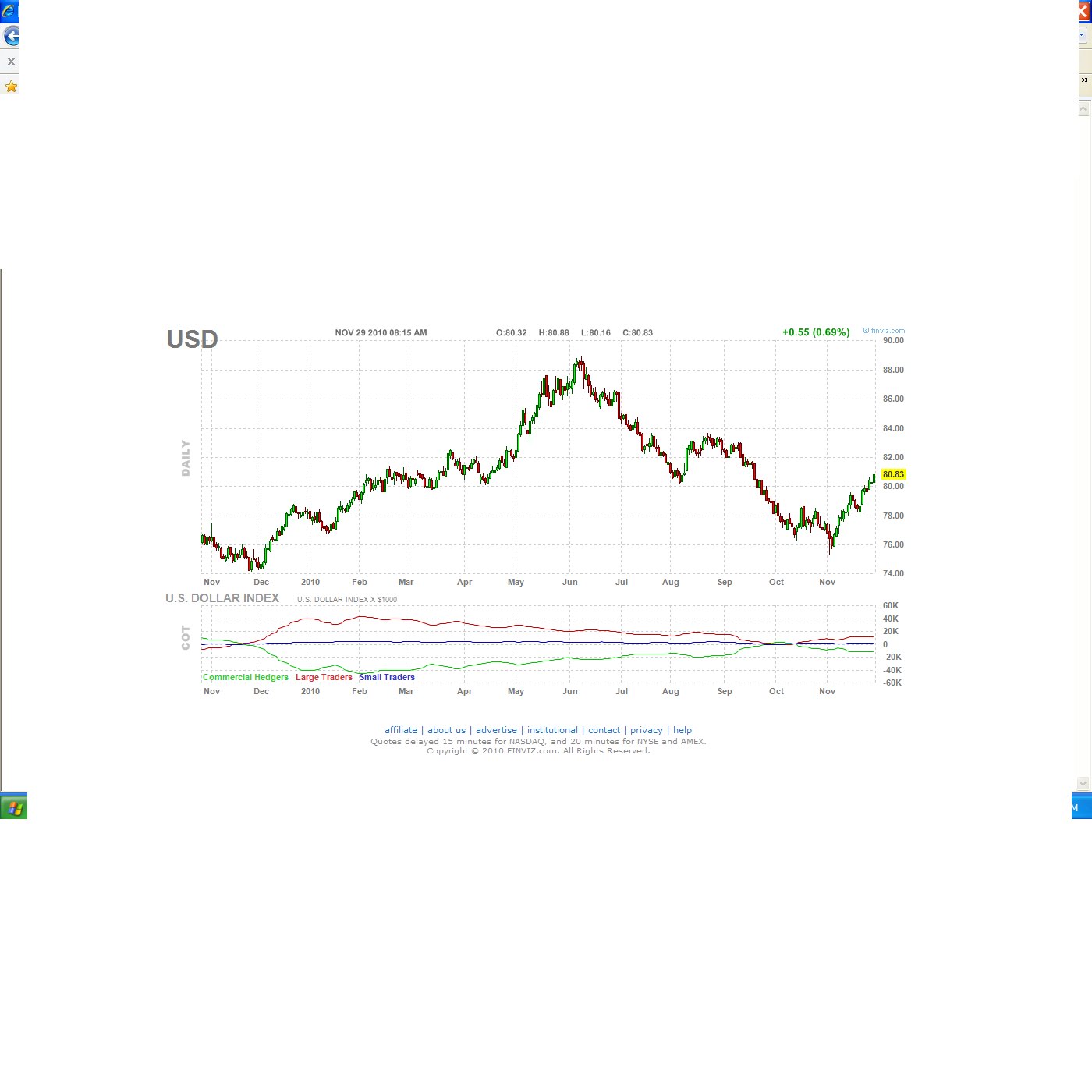
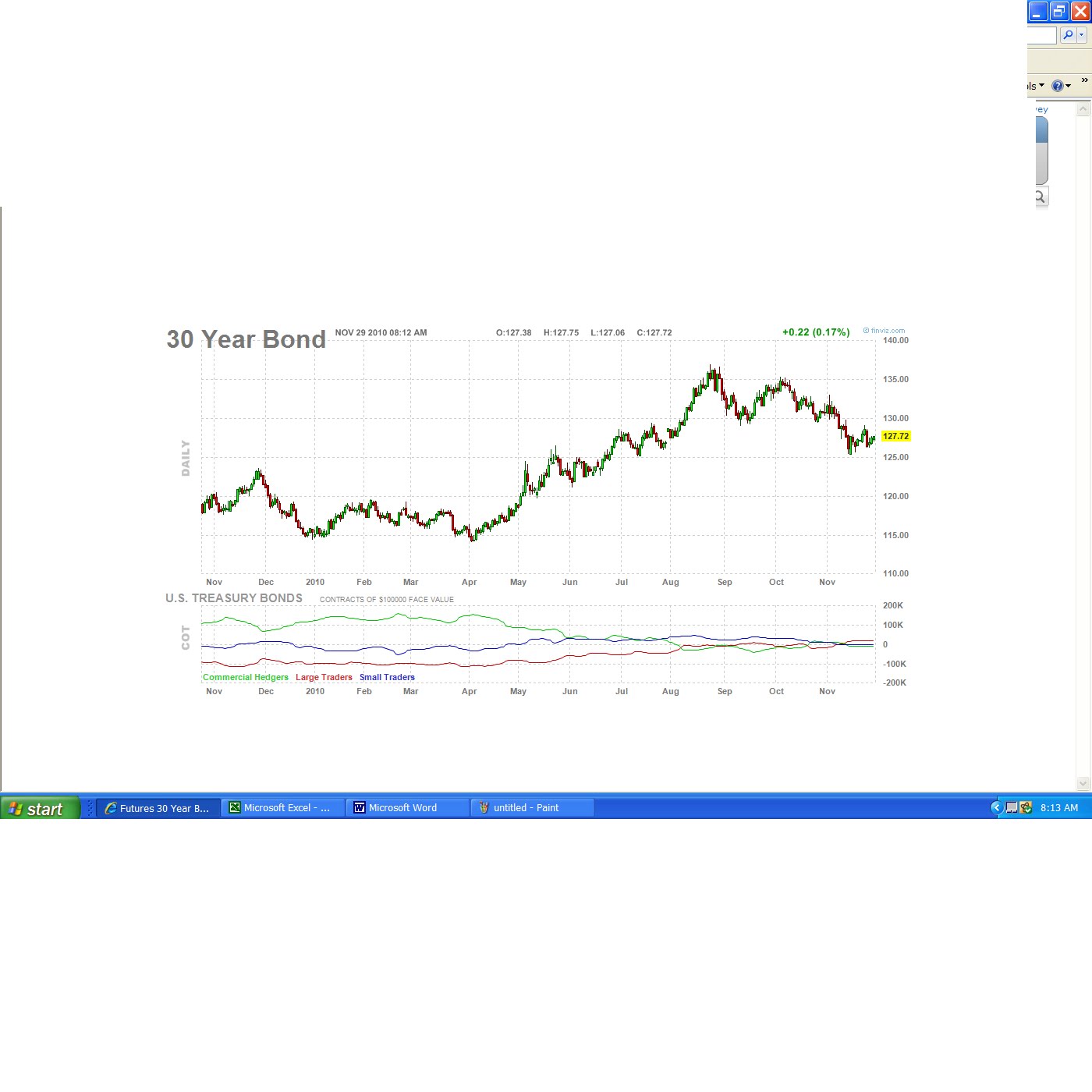
All the reasons for the Fed’s QE2 program have now been explained; they are trying to lower the value of the US dollar, lower long term interest rates, and that they are trying to avoid deflation. A quick look at the US dollar and 30 year bond charts, since early November, show that exactly the opposite is happening.

The US dollar has appreciated and bond prices have gone down; yields have gone up. Does this mean that the program is not having its intended effects? Or does it mean that the markets already anticipated the Fed’s move and moved before the Fed announcement? I know it may be early, but so far, so bad.

I also would not rule out that other countries, particularly China, may be behind this. China has been vocal and has stated that they are not happy with the Fed’s program. Maybe China is dumping some of its bond holdings and buying dollars? Who knows? …but I would not rule this out as a possibility. China has been recently flexing its economic muscle and they have even downgraded US bond credit ratings, so it’s not impossible that they are moving to counter the Fed’s actions.

Monday, November 29, 2010

Mr. Joseph Campbell - Taking the Left Hand Path and Traders

The other day I was watching some lectures given by Mr. Joseph Campbell. Mr. Campbell was known for his interdisciplinary studies in mythology. In his lecture he mentioned taking the “left-hand path” in life. There are many definitions and ideas associated with the left, and the left-hand path, however, in this particular lecture Mr. Campbell was discussing the hero’s journey.

The mythological hero who takes the left hand path is taking the unconventional, not tried, and risky path. The person who follows the right hand path can be considered risk averse, conventional, and comfortable following the herd. The hero who takes the left hand path must be confident, understand that he or she may or may not be helped along the way, and if they return unharmed will be stronger going forward. The strength gained may be emotional, psychological, or physical.

Nonetheless, this all made me think about traders. Traders to me are people who follow the left hand path in life. They deal with risks everyday. The way they trade and their choice of working for money in this way is unconventional. The trader faces difficulties and pressure under stressful market conditions, which are similar to the trial a hero may face. It is during the trial that the hero will succeed. Are you following the left-hand path in life? For those who do, the rewards are enormous.

Saturday, November 27, 2010

Smile and be Thankful...

A guy calls up his stock broker’s office and asks to speak to his broker Mr. Smith. After an awkward pause the receptionist at the other end informs the client that his broker had died. The caller says nothing in response and hangs up the phone.

A while later the client calls up the office again and asks to speak to his broker. The receptionist pauses for a moment and responds by saying "I'm sorry sir, but your broker is dead." Again, the man says nothing and hangs up the phone.

Several hours later the man calls up again making the same request. The bewildered receptionist asks the caller "Haven't you called here already today asking to speak to Mr. Smith?" The caller replies with a simple "No." The receptionist once again informs the gentleman that his broker has died.

Later on that day the same client calls up the office again, asking to speak to his broker. This time the receptionist is certain that it’s the same guy calling again, so she transfers him to the manager. The manager picks up the phone and offers his assistance. After the caller requests to speak to his broker, the manager responds, "Sir, we have records that you have already called here three times today. Each time you ask to speak to your broker and each time we inform you that your broker has passed away. Why do you keep calling? Don't you realize that the man is dead?"

To this the caller responds, "Oh, I realize that he's dead, I just like to hear you say it..."

Tuesday, November 23, 2010

Mr. Andrew Redleaf Lecture

Recently I have been watching videos on Youtube of guest lecturers in Mr. Robert Shiller’s class at Yale. I have recently watched Mr. Andrew Redleaf. What a great source of information these videos are. I encourage you to go into Youtube and search for Yale’s videos.

Mr. Redleaf runs a hedge fund. His lecture centered mostly on efficient markets, the two types of investors that exist, and how he runs his shop. Mr. Redleaf does not believe in the efficiency of markets and describes examples where mispricing and inefficiencies seem to appear; for example, when closed-end funds trade at a discount or premium to the assets they hold, or if a company owns shares in a different company but the value of those shares is not reflected in the stock. One example he gave was when 3Com owned Palm shares.

Mr. Redleaf’s lecture was interesting, but not riveting. What I did like about it and some of the points that interested me were the following:

There are generally two kinds of investors: coupon clippers and security resellers. A coupon clipper is someone who generally analyzes investments from a cash flow perspective. Similar to how bond holders would redeem their coupons and receive the cash flow or interest from their bond holdings. He mentions that Mr. Buffett is a coupon clipper and how Mr. Buffett tends to look for the coupon in equities. Security resellers, on the other hand, are those who buy something and look to resell it at a higher price.

Mr. Redleaf also described the three main concepts his firm uses. The first is that they are coupon clippers. What kind of coupons can we extract is a general philosophy of his. The second is analyzing risk. What’s the worst thing that can go wrong? (By the way he thinks VAR analysis is fundamentally wrong). And lastly, how do we eliminate the risks that we have? He provides an example of these concepts of how his firm may own a high-yield bond and short the stock of the company as a hedge.

I thought the best point made in his lecture was that he likes to think that firms or people get paid to eliminate risk, not for taking it. Overall, I learned something and thought it was interesting. If you have the time, watch it, if not, I think I just outlined his main points.

Friday, November 19, 2010

Mr. Aaron Brown - The Poker Face of Wall Street

I have recently finished reading Mr. Aaron Brown’s book, The Poker Face of Wall Street. I have some mixed emotions about this book. I really liked the economic ideas he presented, but I did not care much for the poker parts. This is because I personally am not interested in poker. However, for those who are interested in poker, I think these parts would be of interest to you. Nonetheless, I did want to read the book, and in the end I am glad I did. I have also added it to my recommended reading list.

I think it would have been better if Mr. Brown separated the subjects of poker and finance into two books. I can understand the relationships between finance and gambling, but I was more interested in his insights on economic history and theory. I enjoyed learning about John Law and Fischer Black’s ideas. I found the section on expected value and utility value interesting. And I can also buy into his thesis that risk and gambling lead to capital concentration and further reinvestment. He did a nice job in all the subjects he discussed. I feel I now have a better understanding of why gambling is important for a society and its economy.

Lastly, Mr. Brown adds detailed references and recommendations of many other books at the end of his book. A good book, in my opinion, stimulates learning and ideas. Mr. Brown’s book did this for me, and I will be reading some of his recommended books in the near future.

Thursday, November 18, 2010

Mr. Barton Biggs and Hedgehogging

Mr. Barton Biggs has written a book called, Hedgehogging. Mr. Biggs used to be the head of Morgan Stanley’s Asset Management business and research groups. He now works for himself at his hedge fund called Traxis Partners LP.

In my opinion, this is not a very catchy title for a book, nonetheless, it really is a very good book to read. When I was younger I worked for a small firm that had close ties to Morgan Stanley and we used the firm for its trading and research. I used to read many research reports, but I remember always wanting to read his research reports and letters to clients.

The book is not a how-to type of book. It is a collection of many stories and ideas that he has gathered over a lifetime of investing. His varied investment experiences and broad thoughts on many topics make the book fun to read and very thought-provoking. I highly recommend it and I am putting in my recommended reading list. I will also be writing about some of the concepts discussed in the book in the near future. Now it’s onto Mr. Soros’ latest book, The Credit Crises of 2008 and What It Means.

Tuesday, November 16, 2010

Why Beauty is Important in Trading Systems and Trading Models – Emini Trading System

In Mr. Arthur Koestler’s book, The Act of Creation, he relates a story that occurred between Mr. Erwin Schrödinger and Mr. Paul Dirac, two founders of quantum mechanic who shared a Nobel Prize in 1933. Mr. Dirac tells a story of how Mr. Schrödinger created his wave equation of the electron. Mr. Schrödinger concentrated on developing his ideas by relying on his thoughts and by making beautiful generalizations, rather than relying closely on experimental data. Mr. Dirac states,

“I think there is a moral to this story, namely that it is more important to have beauty in one’s equations than to have them fit experiment. If Schrödinger had been more confident of his work, he could have published it some months earlier, and he could have published a more accurate equation…It seems that if one is working from the point of view of getting beauty in one’s equations, and if one really has a sound insight, one is on a sure line of progress. If there is not complete agreement between the results of one’s work and experiment, one should not allow oneself to be too discouraged, because the discrepancy may well be due to minor features that are not properly taken into account and that will get cleared up with further developments of the theory...”

I think the moral of this story is that as we develop our trading models and trading systems we too should consider beauty. Are our trading models and systems “beautiful”? Or are they a jumble and a mess of ideas? Mathematicians look at equations and theories and can see beauty in them. All type of art forms have beauty in them. As trading system creators, we too should not forget to make our models “beautiful.”

Joke

A drunk was proudly showing off his new apartment to a couple of his friends late one night, and led the way to his bedroom where there was a big brass gong.

"What's that big brass gong?" one of the guests asked.

"It's not a gong. It's a talking clock," the drunk replied.

"A talking clock? Seriously?" asked his astonished friend.
"Yup," replied the drunk.

"How's it work?" the friend asked, squinting at it.

"Watch," the drunk replied. He picked up the mallet, gave it an ear-shattering pound, and stepped back. The three stood looking at one another for a moment.

Suddenly, someone on the other side of the wall screamed, "You bastard it's ten past three in the morning!"

-from my friend at ZZJoke.com

Monday, November 15, 2010

Mr. Jeremy Grantham's 3Q 2010 Letter

For those of you who are stock investors, reading and utilizing Mr. Grantham's advice may be helpful. I really enjoyed reading this letter.

Friday, November 12, 2010

Mr. Jeremy Grantham's Warning and Advice

Mr. Jeremy Grantham, a partner in the asset management firm Grantham, Mayo, Van Otterloo, was recently interviewed on CNBC. Mr. Grantham has criticized the Fed's actions; both under Mr. Greenspan and Mr. Bernanke. As a professional analyst of bubbles, Mr. Grantham makes the case that the Fed is basically leading us to the next disaster. He feels that both the bond and stock markets are overvalued. Holding cash and being patient will provide options and the opportunity to invest when these market bubbles collapse. His opinion of fair value in the SP500 is around 900. This interview is well worth watching.


Tuesday, November 9, 2010

Mr. Aaron Brown - The Poker Face of Wall Street

Yesterday I began to read this book. I am not a poker player but I am interested to see how he ties the game of poker to finance.

Maybe I'll also learn to how to break Vegas and AC...:)

Monday, November 8, 2010

Mr. Emanuel Derman - My Life as a Quant: Reflections on Physics and Finance

I have just completed reading Mr. Derman's book. I really liked it and would recommend it to anyone interested in modeling, quantitative finance, or financial engineering. I will also be adding it to my recommended reading list.

I will be writing more about this book in the near future.

Saturday, November 6, 2010

Emini System Trading This Week

No trades this week.

Meanwhile here is some humor from ZZJoke.com

There is a new study out about women and how they feel about their ass:

85% of women think their ass is too big...

10% of women think their ass is too little...

The other 5% say that they don't care - they love him and would have married him anyway!!

Friday, November 5, 2010

Working through Underperformance as a System Trader

This is a quote by Eleanor Roosevelt which I would like to share with you. I find it inspiring and helpful.

“The future belongs to those who believe in the beauty of their dreams.”

When times are tough and you are underperforming, especially as a system trader, you need to stay optimistic and know that you will experience good and bad times. It is just the nature of the game. We now have three trading weeks left before we close out the year. I am interested to see how things play out.

Looking at our historical data we know that rough years can occur. This year has been one of them, as was 2002. My models and my heart also tell me that when I look at the historical results, I also see great performance the years following a relatively poor year. Let’s see what happens…

Thursday, November 4, 2010

Mr. Lewis Borsellino and Mr. Robert Shiller - Irrational Exuberance

I have been reading financial books lately. I have now finished Mr. Lewis Borsellino’s book, The Day Trader: From the Pit to the PC. I have also finished reading Irrational Exuberance, by Mr. Robert J. Shiller. It takes a lot, in my own mind of course, to make it into my reading list. Mr. Borsellino’s book does not make the cut because it produced very few, if any, good ideas for me. In other words, it did not make me think much. One criterion of a good book is that it should make one think.

Mr. Shiller’s book, on the other hand, does score a few points on the thinking front. Although the book was quite boring in some parts, I did find it interesting to read. I would recommend it, but I am not going to put it in my reading list. I will, however, be writing about some of the ideas that I thought were important and interesting from Mr. Shiller’s book in the near future.

For now, I would like to go back to Mr. Borsellino’s book and take out, what I thought, was the meat from it. As traders, we instinctively understand this, but it is always good to read things from successful traders who have “been there, and done that.” Here are three quotes from the book:

“Where there is risk, however, there is also fear. Fear cannot be avoided, and it is not a sign of weakness to feel it. The important thing about fear is how to handle it. Mastering fear propels you forward. Letting fear master you paralyzes you.”

“to be successful in life, especially in trading, which puts your money on the line every day, you cannot be a prisoner of your own thoughts.”

In regards to one of the lessons his father taught him, “he gave us stomachs for risk and the ability to push past the fear.”

Good stuff and well worth remembering as a trader and as a human being. What I also like is that he says that fear is not a sign of weakness to feel; it is something to acknowledge, feel, and use.

Wednesday, November 3, 2010

Mr. Lewis J. Borsellino's Book; The Day Trader:From the Pit to the PC

Mr. Lewis J. Borsellino wrote a book called The Day Trader: From the Pit to the PC. Mr. Borsellino was one of the biggest, if not the biggest traders of the S&P futures contract at the Chicago Merc.

Mr. Borsellino’s book was interesting only if you are interested in his autobiography. He relates many stories about himself and of his father. The book, however, is a disappointment if you are looking for trading insights. Although he tells you how he made zillions on trades, he never describes ideas, insights, or methods on how he did it.

I am always looking for new ideas to explore and test. Mr. Borsellino’s book, like many other trading books out there, will disappoint you if you are looking for trading ideas.

Tuesday, November 2, 2010

The Federal Reserve and Quantitative Easing

The Federal Reserve is expected to announce their new policy of “quantitative easing.”

Q. Does anyone really understand what the Fed is doing?

A. Nope.

Q. Does anyone understand if they should do 100 billion, 500 billion, or 1 trillion dollars in purchases?

A. Nope.

Q. Does anyone understand what the effects of this program will be?

A. Nope.

Q. Does anyone understand if they should include mortgage backed securities, 30 year bonds, CDO’s, and generally any garbage that can be purchased?

A. Nope.

Q. Does Wall Street and the market understand what this will really do for the economy?

A. Nope.

Q. Does the Fed itself know what it is doing?

You guessed it…

Have a nice day:)

Friday, October 29, 2010

Greek Debt and Mr. El-Erian

Mr. Mohamed A. El-Erian was recently discussing the Greek debt problem as reported by Bloomberg.com.

He stated that Greece is likely to default on their debt by 2013. Mr. El-Erian felt that, it’s in Greece’s interest to default “as long as you can contain the contagion to other countries and it is done through orderly restructuring and repricing to retain competitiveness.” I definitely agree that it is only a matter of time before the Greeks default, but I have a feeling that it will not be an orderly process. These kinds of things spread like wildfire and can be very difficult to control and keep orderly once they begin to happen.

Mr. El-Erian always seems to be in the news recently. He and Mr. Nouriel Roubini are now officially the twins of doom. I like both of these men, and I am kidding when I say this, but there is some truth to the statement. Mr. El-Erian calls it like he sees it. It is only a matter of time before the overleveraged countries pay for their mistakes. It happens to individuals and it will happen to countries. Greece may be first, but remember, there is line at the door to bankruptcy and default…and it “ain’t going to be purty at all.”

Wednesday, October 27, 2010

The dilemma of market prices and Information Theory

Can information theory help us better understand market price behavior? Information theory states that an unexpected event or signal that occurs contains more informational content than an event that is expected. I can follow the logic of this. But here is the dilemma; if a signal or an event contains more information, it theoretically should reduce uncertainty.

When the market receives unexpected news, prices immediately react, but the sudden reaction in prices does not generally reduce uncertainty, it increases it. In my opinion, given everything else, if the news has been expected, one should expect market prices to be range bound with negative feedback dominating price moves. But if the news is unexpected, then a price breakout in some direction usually occurs. Price breakouts are positive feedback events that generally create herdlike trading. Although the unexpected news event may contain more information, it does not necessarily lessen uncertainty, it increases it. This can lead to trading opportunities for discretionary style traders.

I have difficulty understanding how discretionary traders can make money on a consistent basis. Discretionary traders not only have to figure out what direction prices are going to move, but they also have to determine if the news is expected or unexpected. This is why we see the market move so much when economic figures or earnings are released that differ from the consensus opinion. Consensus is synonymous with expected. Relating the actual figure to the consensus number is another aspect that a discretionary trader has to take into account. Then, if that is not hard enough, the discretionary trader has to figure how far and in what timeframe prices will move. Is it not better to trade the market systematically? I think so.

Tuesday, October 26, 2010

Mr. Paul Krugman and British Economic Policy

Mr. Paul Krugman, in his column in The New York Times, criticized the recently adopted policies of the British government. Mr. Krugman argues that cutting deficits during difficult economic times is not good policy. This is an argument that many economists make.

I can understand their line of reasoning. The problem though, as I see it, is that politicians and governments rarely, if ever, follow through with deficit reduction policies when economic times are better. Cutting spending, increasing taxes, reducing fat, and taking the more harsh measures that are required to reduce deficits is difficult to do when times are good. What politician wants to take away the punch bowl and spoil the party when times are good?

Economists may be right in their opinions about deficit reduction during economic distress; but human nature, self-interest, and greed works against them. You cannot have it both ways; either you cut deficits when times are good, or you cut them when times are bad. Humans sometimes need to actually experience pain before they do something about it. Recessions and economic slowdowns are the pain that wakes people up.

Monday, October 25, 2010

Britain pays the piper while the U.S. tells him to "F" off..

It is only a matter of time before the United States adopts similar policies that the British have recently announced. Unfortunately, our politicians do not have the “balls,” pardon my French, to do so. In Britain, it is time to pay the piper. In America, we do not want to believe that the piper has to get paid.

The Conservative led government in Britain has announced drastic cuts in public spending and initiated a variety of policies to control their public deficit. The public deficit as a percent of economic output in Britain is 11.5%, in America it is 10.7%. The British have announced 83 billion pound spending cuts, or 130 billion USD. The announced policies seem draconian; 19% cuts across all government departments, 490,000 public sector employees to be laid off, payment cuts to the long term unemployed, limits announced on jobless benefits and to welfare recipients, an increase in the retirement age, cuts in the arts and police, and higher value added taxes.

In my opinion, this kind of thing will eventually occur in the U.S. We just do not want to admit it…yet. The British have decided that they must face the music if they want to dance. In America, we do not want to hear the music, never mind dancing to it.

Friday, October 22, 2010

Something for the end of the week

From my friend at ZZJoke.com...

HOW TO KEEP A HEALTHY LEVEL OF INSANITY:

1. AT LUNCH TIME, SIT IN YOUR PARKED CAR W/ SUNGLASSES ON AND POINT A HAIRDRYER AT PASSING CARS. SEE IF THEY SLOW DOWN.

2. PAGE YOURSELF OVER THE INTERCOM. DON'T DISGUISE YOUR VOICE.

3. EVERY TIME SOMEONE ASKS YOU TO DO SOMETHING, ASK IF THEY WANT FRIES WITH THAT.

4. PUT YOUR GARBAGE CAN ON YOUR DESK AND LABEL IT "IN"

5. PUT DECAF IN THE COFFEE MAKER FOR 3 WEEKS. ONCE EVERYONE HAS GOTTEN OVER THEIR CAFFEINE ADDICTIONS, SWITCH TO ESPRESSO.

6. WRITE "FOR SEXUAL FAVORS" IN THE MEMO LINE OF ALL YOUR CHECKS.

7. FINISH ALL YOUR SENTENCES WITH "IN ACCORDANCE WITH THE PROPHECY."

8. DONT USE ANY PUNCTUATION

9. AS OFTEN AS POSSIBLE, SKIP RATHER THAN WALK.

10. ASK PEOPLE WHAT SEX THEY ARE. LAUGH HYSTERICALLY AFTER THEY ANSWER.

11. SPECIFY THAT YOUR DRIVE-THROUGH ORDER IS "TO GO".

12. SING ALONG AT THE OPERA.

13. GO TO A POETRY RECITAL AND ASK WHY THE POEMS DON'T RHYME.

14. PUT MOSQUITO NETTING AROUND YOUR WORK AREA. PLAY A TAPE OF JUNGLE SOUNDS ALL DAY.

15. FIVE DAYS IN ADVANCE, TELL YOUR FRIENDS YOU CAN'T ATTEND THEIR PARTY BECAUSE YOU'RE NOT IN THE MOOD.

16. HAVE YOUR COWORKERS ADDRESS YOU BY YOUR WRESTLING NAME, ROCK HARD ________.

17. WHEN THE MONEY COMES OUT THE ATM, SCREAM "I WON!","I WON!" "3RD TIME THIS WEEK!!!!!

18. WHEN LEAVING THE ZOO, START RUNNING TOWARDS THE PARKING LOT, YELLING "RUN FOR YOUR LIVES, THEY'RE LOOSE!!"

19. TELL YOUR CHILDREN OVER DINNER, "DUE TO THE ECONOMY, WE ARE GOING TO HAVE TO LET ONE OF YOU GO." AND THE FINAL WAY TO KEEP A HEALTHY LEVEL OF INSANITY.......

20. SEND THIS E-MAIL TO EVERYONE IN YOUR ADDRESS BOOK, EVEN IF THEY SENT IT TO YOU OR ASKED YOU NOT TO SEND THEM STUFF LIKE THIS.

Thursday, October 21, 2010

The Right Attitude for Trading

“Winning is not everything, but wanting to win is.”

-Vince Lombardi

As traders we must have this attitude in order to succeed. The hard part is maintaining this attitude when we are getting tossed around with losses and or experiencing drawdowns in our trading systems and trading models. Faith, confidence, and perseverance are the only way through the tough times…

Friday, October 15, 2010

Some good advice for quantitative traders from Mr. Paul Wilmott

Here is some good advice for trading model builders and quants…

In my view the main reason why quantitative finance is in a mess is because of complexity and obscurity. Quants are making their models increasingly complicated, in the belief that they are making improvements. This is not the case. More often than not each ‘improvement’ is a step backwards. If this were a proper hard science then there would be a reason for trying to perfect models. But finance is not a hard science, one in which you can conduct experiments for which the results are repeatable. Finance, thanks to it being underpinned by human beings and their wonderfully irrational behaviour, is forever changing. It is therefore much better to focus your attention on making the models robust and transparent rather than ever more intricate.

Source :Paul Wilmott’s blog

The idea is to keep it simple…

Tuesday, October 12, 2010

FROM ZZJOKE.COM - Jokes

for a change of pace...

A man and his wife are awakened at 3 o'clock in the morning by a loud pounding on the door.

The man gets up and goes to the door where a drunken stranger standing in the pouring rain is asking for a push. "Not a chance" says the husband "It's three o'clock in the morning!"

He slams the door and returns to bed. "Who was it?" asks his wife.

"Just a drunken stranger asking for a push" he answers.

"Did you help him?" she asks.

"NO, I didn't, it's 3 o'clock in the morning and it's pouring rain!!"

"Well, you've got a short memory" says his wife. "Can't you remember about three months ago when we broke down on vacation and those two guys helped us out? I think you should help him."

The man does as he is told and gets dressed and goes out in the pouring rain and calls out into the dark, "Hello, are you still there?"

"Yes," comes the answer.

"Do you still want a push?" calls out the husband.

"Yes, please!" comes the reply from the dark.

"Where are you?" asks the husband

"Over here, on the swing" the drunk replies...

Friday, October 8, 2010

Mr. Jim Simons, High Frequency Trading, and the Flash Crash

The Wall Street Journal reported that Mr. Jim Simons gave an interview on CNBC in regards to high frequency trading (HFT) and the flash crash.

During the interview Mr. Simons stated that HFT helped the market recover quickly compared to how long it took the market to recover from the 1987 crash. I find this interesting. I respect Mr. Simons and admire his success, but I feel his opinion is biased and flawed. Renaissance Technologies, his firm, is known to use HFT, so how can he be objective? How can you respond to what happened after the crash and not address what or why it happened before it occurred? How can you feel HFT helped the situation, when in fact, HFT was one of the major reasons of why the crash occurred in the first place?

For example, if you cannot swim and I push you into the water, then I jump in and save you, should you consider me a hero? In my opinion, Mr. Simons would have been better off not making any public comments in regards to this matter. HFT is here to stay, but the public’s confidence in the market and the system has been shaken by it.

Friday, October 1, 2010

Managing Drawdown Periods in Trading Systems - emini trading - emini trading system

All successful traders have trading plans for both good trading times and the negative periods. Negative trading periods are known as drawdowns. I wonder how the term came about, but one can guess that these periods are called drawdowns because they not only reduce our accounts, but that they also draw us down emotionally.

So how can we handle “draw us down” periods? In my humble opinion, the best way to handle drawdown periods is through confidence, faith, and disciplined money management. Confidence and faith are interrelated. Confidence increases over time. The longer we successfully trade our models, the more confident we become. Prior drawdown periods and negative emotional experiences also can help us better manage and understand current drawdown periods. “What doesn’t kill us makes us stronger” and “diamonds are made under pressure,” are two sayings I like to think about when I am in drawdown periods.

Ms. Rosabeth Moss Kanter, a Harvard Business School professor, was asked about what confidence is in an interview. Her response was, “confidence is a situational expectation—an expectation of a positive outcome.” This is relevant to traders who use trading systems and models. Every time we trade we have a situation where we should have an expectation of a positive outcome. Our trading models should have positive expectation. Positive expectation can be calculated from our trading research. But positive expectation cannot, however, be calculated in our emotional states. This comes from faith; faith in our selves, faith in our trading models, and faith from above.

Wednesday, September 29, 2010

Some tips on handling drawdowns - Kanter's Law - Emini system trading

I was recently reading some articles on Bloomberg.com and came across one which referred to Ms. Rosabeth Moss Kanter. Ms. Kanter is a professor at the Harvard Business School. Following the links in the article led me to this interview which I thought was interesting and I would like to share with you.

One of the things she is known for is her Kanter Law. This law states that, “everything can look like failure in the middle.” If you have been following our S&P500 emini trading system you will know that we are currently in a drawdown period. Drawdowns can feel like failure. The feelings they create are difficult to describe, but if you trade you should be able to immediately relate to these undesirable feelings. Nonetheless, Ms. Kanter’s law states that it is helpful to look at the situation as if you are in the middle of a process when things are not going well.

As a systematic trader, I find this perspective useful. By considering drawdowns as if I am in the middle of them, gives me perspective, and allows me to have confidence going forward. Being in the middle of a drawdown period is rough, but having the right emotional and financial tools gives one the confidence to manage it. Faith, confidence, and perspective are your emotional tools as a systematic trader. Disciplined money management is your financial tool to get through drawdown periods.

Drawdowns are similar to being in the middle of a process. As systematic traders, we must always be ready to face drawdowns and the feelings they create. Solid trading models, confidence, faith, and the Kanter Law can all help pull us through the middle of this process called drawdown.

Tuesday, September 28, 2010

Are there limits to logic? Emini trading system - Emini

Are there limits to logic? If markets behaved logically the underlying logic would eventually be discovered, traders would make excess profits, and the markets would breakdown and cease to exist. In general, new traders believe that rational and logical ideas should make profits when applied to markets. But more experienced traders rely less on logic and the rational. Experienced traders accept chance and probability as the primary determinants of trading models. Armed with this knowledge they understand the odds of the game and use a disciplined money management system to minimize risk and maximize profits.

Probability and chance not only drive our trading models, they also occur spontaneously whenever we set out to find or discover something. Louis Pasteur once stated that, “chance only favours invention for minds which are prepared for discoveries by patient study and persevering efforts.” In regards to trading this means that traders need to study the markets as much as possible, be persevering, and eventually a useful trading idea may occur. It takes a long time and it is not easy.

Creativity involves a mix of conscious and unconscious thoughts and processes. Conscious reasoning is logical and rational. The unconscious is not logical. The unconscious puts limits on logic. In order to succeed we must immerse ourselves in the ideas, thoughts, and research and then step back and allow the unconscious to process all the information. Sometimes the more we seek something the more it eludes us. Seek not, and you shall find, may be more useful in the creative process. This is one way to build successful trading systems and models.

Wednesday, September 22, 2010

Does God Play Dice in the Markets?

Mr. Albert Einstein once said that he could not believe God plays dice with the world. He felt that there was a hidden order to things. He did not want to accept the statistical probability ideas being developed in quantum mechanics. I wonder what he might have thought of markets and trading.

As a physicist he might disregard trading as behavioral and better understood through psychology. As traders we trade the markets and make and lose money with the ideas that we apply to the markets. The chance and probability of success rests on our trading models. Is there a hidden order in the markets? Is it all chance and probability? What do you think?

Tuesday, September 21, 2010

ZZJOKE.COM

Here's a sample from ZZjoke.com

A woman could never get her husband to do anything around the house. He would come home from work, sit in front of the tv, eat dinner, and sit some more -- would never do those little household repairs that most husbands take care of. This frustrated the woman quite a bit.

One day the toilet stopped up. When her husband got home, she said sweetly, "Honey, the toilet is clogged. Would you look at it?" Her husband snarled, "What do I look like? The tidy-bowl man?" and sat down on the sofa.

The next day, the garbage disposal wouldn't work. When her husband got home, she said, very nicely, "Honey, the disposal won't work. Would you try to fix it for me?" Once again, he growled, "What do I look like? Mr. Plumber?"

The next day, the washing machine was on the blink. When her husband got home, she steeled her courage and said, "Honey, the washer isn't running. Would you check on it?" And again was met with a snarl, "What do I look like? The Maytag repairman?"

Finally, she had had enough. The next morning, the woman called three repairmen to fix the toilet, the garbage disposal, and the washer. When her husband got home, she said, "Honey, I had the repairmen out today."

He frowned, "Well, how much is that going to cost?" "Well, honey, they all said I could pay them by baking them a cake or having sex with them." "Well, what kind of cakes did you bake them?" he asked.

She smiled. "What do I look like? Betty Crocker?"

Monday, September 20, 2010

Trading Systems and Aesthetics

In Mr. Koestler’s book, The Act of Creation, he discusses perceptions…

“when two independent matrices of perception or reasoning interact with each other the result is either a collision ending in laughter, or their fusion in a new intellectual synthesis, or their confrontation in an aesthetic experience.”

What I find interesting in the above quote is that he uses the word confrontation in regards to having an aesthetic experience. In most art forms, the build up of tension and confrontation, and the subsequent resolving of these, help create the aesthetic experience. There generally is a thesis, antithesis, and a synthesis in art. The same is true in building trading models. This is why trading is sometimes described as an art.

There is inherent tension in building trading models. The concepts and our perceptions of the market that underlie the model may seem illogical. Nonetheless, by bringing what may seem as illogical and discordant ideas into trading models increases the chances of creating a better trading model. Successful trading models really are a combination of both art and skill.

Monday, September 13, 2010

Winning Trading Systems and Bisociation

In Mr. Arthur Koestler’s book, The Act of Creation, he discusses the logic of laughter. I have recently written about Mr. John Cleese and his thoughts regarding humor and what is needed in order to be creative. Both men share similar ideas which can be applied to trading models and trading systems.

Mr. Koestler states that humor occurs when there is, “the perceiving of an idea…in two self-consistent but habitually incompatible frames of reference.” The “idea” here is similar to the main idea of our trading model and the frames of reference underlying the trading system. Successful and robust trading systems usually operate within various frames of reference, for example, two or more time frames, markets, or events.

When we “get” a joke, we are usually relating the idea of the joke to two or more frames of reference. When we trade, we use various frames of reference for the trade to setup. But when we trade we always seem to use time as one of those frames of reference. It may be the time frame we choose to trade in, or the use of two or more time frames to setup the trade. I wonder if there is any way we can avoid the concept of time when we trade? And if time is usually one frame of reference, what is the other, non-time frame of reference we use? Maybe this is what Mr. Koestler discusses as “incompatible” frames of reference. As a systematic trader I tend to think about things like this.

Mr. Koestler uses the term bisociation to refer to things that operate on two planes or frames of reference. He further states that simple, routine thinking operates on a single plane, whereas the creative act always operates on one or more planes. Successful trading systems are usually bisociative, like any art form.

Thursday, September 9, 2010

What's so funny about emini trading models and trading systems?

Here are a few more ideas regarding creativity from Mr. John Cleese. Mr. Cleese spoke about putting in extra time and being persistent when coming up with creative solutions. Constant and conscious thinking about creative solutions also allows our unconscious to process the information in the background. I believe many of us have thought about problems only to find the solutions and answers later on and in some unexpected way.

Mr. Cleese also tells us that creativity is similar to humor. When we understand a joke and laugh we are usually connecting two different frameworks of reference in some new way. Connecting frameworks or ideas is also useful in building winning trading models and systems. By researching and finding patterns and relationships, we create the foundation for a trading system. This can be very similar to finding humor in a joke.

When I first started trading I read everything I could about it. This was helpful, but only to a point. By reading I was able to absorb many ideas, but by being creative and persistent, I was able to find relationships to test. Mr. Cleese states that new connections are only significant if they generate new meaning. So as you think creatively and play with ideas, try putting together random concepts and look at them with your intuition to determine if there is anything significant about them--then test the relationships.

Lastly, it is important to know when to relax and to take a step back. Sometimes we just push and push and make no progress. At this point it is important for us to recognize that we need to take a break. By taking a break we let our brains and unconscious process the information and ideas we have been churning. This, in itself, can sometimes lead to a creative solution.

Wednesday, September 8, 2010

How to be creative in building successful trading models and trading systems

Being creative is essential to building successful and winning trading models. Learning how to be creative can also help us succeed in anything we desire in our lives. If you are familiar with Monty Python’s Flying Circus you may remember Mr. John Cleese. Mr. Cleese played an instrumental part in the success of the show due to his energy and ability to be creative. Mr. Cleese also went on to become a very successful business entrepreneur after Monty Python. I recently read an article in which he discussed creativity and how to be more creative.

Mr. Cleese states that creativity is a way of operating--a mode of behaving. It is being “child-like” and having the ability to play. People who have this ability tend to think freely, explore ideas for fun, and find enjoyment in the process.

Mr. Cleese states that people operate in two modes, open and closed. The closed mode is productive, serious, and pressured. It is the mode that we are in when we are at work. It is purposeful, but not creative. In contrast, the open mode is relaxed, expansive, and less purposeful. It is a mode where we can be curious, participate in thought experiments, and think about “what-if” situations. Both modes are important, and the ability to switch between them is essential in order to be efficient.

There are five aspects to the open mode: space, time, time, confidence, and humor. The first is space. In order to begin the creative process you must make some space for yourself and seal yourself in from outside demands. Find a place where you cannot be disturbed.

Second, create a specific amount of time in order to be creative. He suggests an hour and a half. He also suggests smaller, frequent increments of time for creative thinking are better than longer, less frequent sessions.

Next is time again. Mr. Cleese stressed that he felt more creative when he “stuck to the problem” longer than others would. He would give it even more time. The most creative professionals are the ones who are prepared to play with the problem longer before resolving it. I believe this is the key point of succeeding at anything you do in life. In my case, building successful trading models took a long time and required discipline and a lot of perseverance.

The fourth aspect of being creative in the open mode is having confidence. Creativity feeds on itself. The more creative you are, the more confidence you will have, this leads to being even more creative. Mr. Cleese also stressed that when you are in the open mode you need to let the ideas flow. Play is experiment. Refrain from judging yourself or the ideas. Do not be afraid or fearful of making a mistake. Nothing paralyzes the creative, open mode more than fear.

Lastly, Mr. Cleese stressed the importance of bringing humor to the process. Humor creates spontaneity, it is essential to being playful, and can be very useful in solving problems. I hope this article helps you understand how to be creative. Now go and use these ideas to make money trading or to pursue anything else you desire in your life.

Tuesday, September 7, 2010

One more Vince Lombardi

With football season just around the corner, and in honor of a great motivator and coach, here is one more Vince Lombardi link worth watching...http://www.simpletruths.tv/store/movies.php?movie=nmbo

Sunday, September 5, 2010

Wednesday, September 1, 2010

Vince Lombardi Speech on Winning

So I'm back from the mountains and found this inspiring speech to share...


Winning is not a sometime thing; it’s an all the time thing. You don’t win once in a while; you don’t do things right once in a while; you do them right all the time. Winning is a habit. Unfortunately, so is losing.

There is no room for second place. There is only one place in my game, and that’s first place. I have finished second twice in my time at Green Bay, and I don’t want to finish second again. There is a second place bowl game, but it is a game for losers played by losers. It is and always has been an American zeal to be first in anything we do, and to win, and to win, and to win.

Every time a football player goes to ply his trade, he’s got to play from the ground up—from the soles of his feet right up to his head. Every inch of him has to play. Some guys play with their heads. That’s O.K. You’ve got to be smart to be number one in any business. But more importantly, you’ve got to play with your heart, with every fiber of your body. If you’re lucky enough to find a guy with a lot of head and a lot of heart, he’s never going to come off the field second.

Running a football team is no different than running any other kind of organization—an army, political party or a business. The principles are the same. The object is to win—to beat the other guy. Maybe that sounds hard or cruel. I don’t think it is.

It is a reality of life that men are competitive and the most competitive games draw the most competitive men. That’s why they are there—to compete. To know the rules and objectives when they get in the game. The object is to win fairly, squarely, by the rules—but to win.

And in truth, I’ve never known a man worth his salt who in the long run, deep down in his heart, didn’t appreciate the grind, the discipline. There is something in good men that really yearns for discipline and the harsh reality of head to head combat.

I don’t say these things because I believe in the “brute” nature of man or that men must be brutalized to be combative. I believe in God, and I believe in human decency. But I firmly believe that any man’s finest hour—his greatest fulfillment to all he holds dear—is that moment when he has to work his heart out in a good cause and he’s exhausted on the field of battle—victorious.

Vince Lombardi